1What 'Bad Credit' Actually Means for Lenders
Bad credit isn't a single thing. It's a spectrum with different causes, different implications, and different borrowing options depending on where you fall.
Generally speaking, 'bad credit' in the lending industry refers to FICO scores below 580-620. But the more useful breakdown:
580-619: Subprime. Most prime lenders (SoFi, LightStream, Marcus) reject you outright. Upstart, Avant, and some credit unions can work with you. Rates will be 25-35%.
550-579: Deep subprime. Options narrow to Avant, OneMain, and credit unions with specific programs. Rates hit the ceiling — 30-36%.
Below 550: Conventional personal loan options are mostly exhausted. OneMain will sometimes approve below 550 with a secured loan or a co-signer. Credit union PALs (Payday Alternative Loans) are worth exploring. Beyond that, the options start looking like predatory products.
Bad credit has different causes and lenders treat them differently: - High utilization (cards maxed out): temporary, can improve fast when paid down - Late payments: weighted heavily by FICO, takes 2+ years to fade - Collections accounts: damaging and persistent - Bankruptcy: severe, Chapter 7 stays on report for 10 years - No credit history (thin file): different from bad credit — some lenders handle this better
Upstart's AI model distinguishes between these better than FICO does. Someone with a 600 score due to maxed-out cards and otherwise clean history will get treated differently than someone with a 600 score due to collections and missed payments.
2Upstart — Best AI-Underwritten Loans for Non-Traditional Profiles
Upstart is genuinely different from every other lender on this list. They built their business on the thesis that FICO is a bad predictor of repayment ability for certain borrower profiles — and the data has largely validated this.
Their model looks at education, field of study, employment history, job tenure, income trajectory, and 1,600+ additional data points beyond credit score. The practical effect: they approve borrowers with 580-620 scores that banks reflexively reject, especially if those borrowers have strong income, stable employment, or educational backgrounds that correlate with low default rates.
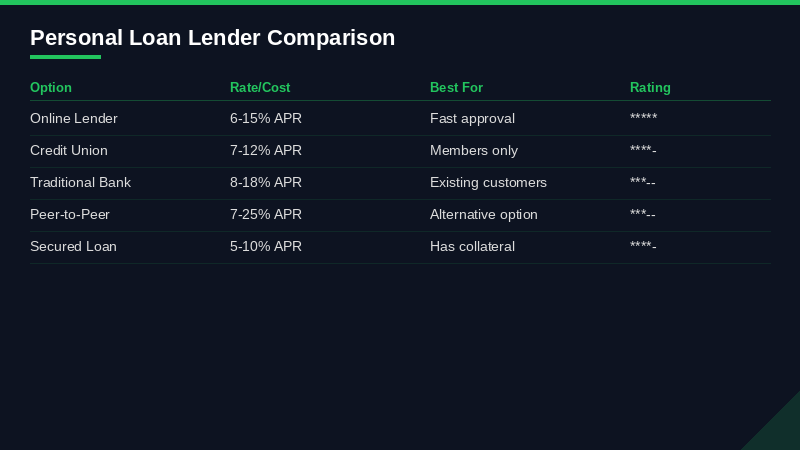
APR range: 7.40% – 35.99%. For borrowers in the 580-620 range, expect the 25-35% portion of that range. The low floor is real but reserved for well-qualified borrowers.
Loan amounts: $1,000 – $50,000.
Origination fee: 0% – 12%. This is Upstart's biggest problem. The origination fee can be brutal. A 580-score borrower approved at 30% APR with a 10% origination fee on a $10K loan is paying $1,000 upfront just to access the funds. That's $9,000 in proceeds against $10,000 in debt. Run the numbers. The total cost might still beat a payday loan by a mile, but it's not cheap.
Funding speed: typically 1 business day.
Credit requirement: 300 minimum (technically). In practice, they approve in the 580-620 range regularly. They also approve thin-file borrowers — recent grads, people new to credit — better than almost anyone.
Upstart's data on their model: they claim to approve 43% more applicants than traditional models at equivalent loss rates and to provide 16% lower rates on average to approved applicants. The independent validation of these claims is mixed, but anecdotally — they approve people who shouldn't be turned away and often aren't dramatically overcharging relative to the risk they're taking on.
Who Upstart is for: borrowers with 580-650 credit, thin files, or non-traditional income profiles. If you've been rejected by SoFi, LightStream, and Marcus, try Upstart before moving to Avant.
3Avant — Most Transparent Bad Credit Lender
Avant exists specifically for the 550-680 credit range and they've built their product around that target customer. The application is honest about what they need, the terms are disclosed clearly, and unlike some subprime lenders, they don't try to obscure the true cost.
APR range: 9.95% – 35.99%. For borrowers in their target range, expect 24-35%. The 9.95% floor is for their best-qualified borrowers (650-680 range, strong income, low DTI).
Loan amounts: $2,000 – $35,000.
Origination fee: up to 9.99% (they call it an administration fee — same thing). The fee is disclosed upfront and included in the APR calculation, which is how it should work.
Funding speed: next business day for most approvals.
Credit requirement: 550.
Avant's credit reporting: they report to all three bureaus (Equifax, Experian, TransUnion). If you make 24 months of on-time payments on an Avant loan, your score should improve materially. Depending on what else is on your report, you might move from 580 to 620-640 over the loan term — enough to unlock better options next time.
The thing Avant does that many subprime lenders don't: they have real customer service. Phone support, email support, actual humans. Not just an automated portal that rejects you without explanation. When you're managing finances under stress, this matters more than people give it credit for.
Real rate transparency test: Avant's pre-qualification tool gives you an actual rate offer after a soft pull. If the offer is 34.99% on a $5K loan, you know before committing. No surprise at the end of the process.
Who Avant is for: borrowers in the 550-680 range who want transparent terms, real customer service, and a lender who's honest about what they're offering.
OneMain is the last real option before you're into genuinely predatory territory — and they're not predatory.
4OneMain Financial — Best for Very Poor Credit
OneMain is the last real option before you're into genuinely predatory territory — and they're not predatory. They're expensive, but they lend to people nobody else will lend to, and they do it with disclosed rates and physical locations.
APR range: 18.00% – 35.99%. There is no teaser floor here. Everyone with bad credit gets rates in the 20-36% range. The 18% floor exists for their better-qualified borrowers with secured loans.
Loan amounts: $1,500 – $20,000.
Origination fee: varies by state. Some states cap at a flat fee ($25-$150), others allow percentage-based fees up to 10%. Check your state's rules.
Funding speed: same day or next day if you close at a branch. This is OneMain's operational advantage — with 1,400+ branches, you can often walk in and walk out with money same-day.
Credit requirement: no stated minimum. They review all applications. Approvals exist in the 500-550 range, especially with collateral.
OneMain's secured personal loans: using your car as collateral can drop your rate by 3-5 percentage points. If your car is paid off or nearly paid off and you own it outright, a secured loan at 22% beats an unsecured loan at 27% by a meaningful margin over 3 years. The risk: default means they can repossess the car. Only use this if your repayment plan is realistic.
Why the branch network matters: some bad-credit borrowers have documentation challenges (unusual income, multiple jobs, cash income) that are easier to explain in person than through an automated portal. OneMain's reps work with complex situations. A two-gig-worker with $50K/year in combined income but unusual pay stubs might get denied online everywhere but approved after an in-branch conversation.
Who OneMain is for: borrowers below 580 who've been rejected elsewhere, borrowers who need same-day cash and have a branch nearby, and borrowers with complex income documentation that doesn't fit automated underwriting.
5Credit Unions — The Underrated Option
Most bad-credit content skips credit unions because they don't pay affiliate commissions. That's a significant omission.
Federal credit unions are member-owned, not-for-profit institutions regulated by the NCUA. Their lending rates are capped by federal law — personal loans can't exceed 18% APR, and Payday Alternative Loans (PALs) are capped at 28% APR.
PALs specifically: PAL I loans are $200-$1,000 for 1-6 months. PAL II loans are $1-$2,000 for up to 12 months. Both are capped at 28% APR. The application fee can't exceed $20. For small-dollar emergency needs, nothing beats this.
Credit union personal loans: most credit unions require you to be a member first, and many have loose membership requirements (living in a county, working in an industry, being affiliated with an employer or association). Worth checking your eligibility.
For bad-credit borrowers specifically, credit unions are more willing to consider the whole picture. They're not running your application through a rigid algorithm — a loan officer looks at your situation, your relationship with the credit union, your income, and makes a judgment call. Someone with a 580 score and 5 years of membership at a credit union with direct deposit has a meaningfully better shot than a cold application at a digital lender.
Statewide and regional credit unions to check: Navy Federal (military/DOD employees and family), PenFed (open membership), Alliant, First Tech Federal. These are large enough to have robust loan products while retaining credit union rate structures.
Bottom line: before applying to Avant or OneMain at 30-35%, check whether you're eligible to join a credit union with reasonable personal loan rates. The membership signup takes 20 minutes. The rate difference could be 10-15 percentage points.
6Secured Personal Loans — Lower Rates at the Cost of Collateral
Secured personal loans use collateral — typically your car, savings account, or CD — to back the loan. Because the lender has recourse, they take on less risk, and the rates come down accordingly.
Types of secured personal loan collateral:
Car title: OneMain, some credit unions, and specialist lenders offer car-secured personal loans. Distinct from title loans (which are predatory short-term products) — secured personal loans have fixed terms, reasonable rates, and actual underwriting. OneMain's secured product is a legitimate option.
Savings account or CD: called a share-secured loan at credit unions. You borrow against your own savings balance. The rate is typically the savings rate plus 1-3%. On a CD paying 4.5%, you might borrow at 5.5-6%. This sounds silly (why borrow against your own money?) but the purpose is credit-building — you keep the savings earning interest while the loan payment history builds your credit profile. Useful strategy.
Home equity: technically personal but effectively a HELOC. Rates are much lower (7-10%) because your home is collateral. The risk is obvious — default can lead to foreclosure. Don't use this for consumer debt you're uncertain about repaying.
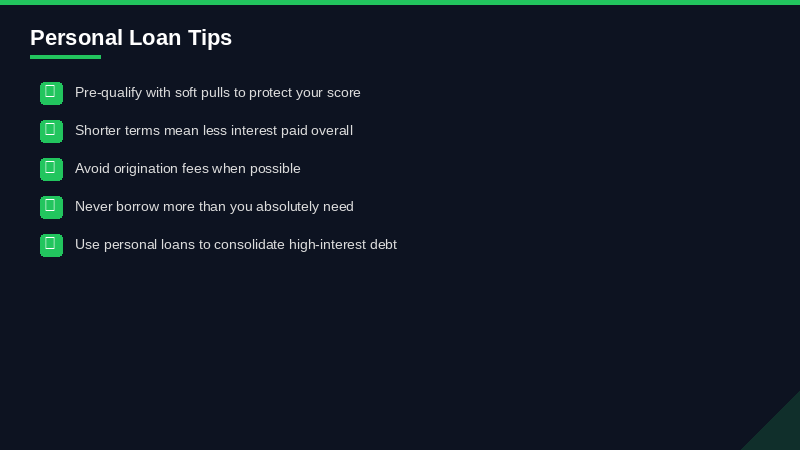
The math on secured vs unsecured for bad credit: - Unsecured loan at 30% APR on $8,000, 36 months: monthly payment $310, total interest $3,160 - Secured (car) loan at 24% APR on $8,000, 36 months: monthly payment $289, total interest $2,404 - Savings: $756 in interest — not trivial
Only collateralize if you're confident in repayment. A missed payment on an unsecured loan is a credit ding. A missed payment on a car-secured loan is a credit ding plus potential repossession.
7Red Flags — How to Spot Predatory Lenders
Bad-credit borrowers are the most targeted demographic for predatory lending. When you're financially stressed and being rejected, an offer that says 'yes' feels like a lifeline. Some of those 'yes' offers will make your situation significantly worse.
Red flag 1: Triple-digit APR. Payday loans, some online installment lenders, and cash advance apps charge 100-400% APR. No legitimate personal lender on any reputable list goes above 36%. If the disclosed APR (not the 'fee per $100' framing some use to obscure it) is above 36%, walk away.
Red flag 2: Upfront fees before loan disbursement. Legitimate lenders deduct origination fees from your proceeds — they don't ask for payment before funding. Any lender asking for an upfront wire transfer, gift card, or fee payment before they'll release funds is a scam.
Red flag 3: No credit check, guaranteed approval. Every real lender checks your credit in some form. 'Guaranteed approval' lenders are either charging unconscionable rates, collecting your information for fraud, or both.
Red flag 4: Pressure to borrow more than you need. If the lender is pushing you toward a higher loan amount than you requested, they're prioritizing their fee revenue over your financial wellbeing. Take exactly what you need.
Red flag 5: Vague or missing APR disclosure. Federal law (Truth in Lending Act) requires lenders to disclose APR prominently before you sign. If you're being asked to sign without clear APR disclosure, stop.
Red flag 6: Automatic renewal or balloon payments. Some installment loan products are designed to roll over — you make minimum payments that barely cover interest, and at the end of the term there's a large balloon payment due. Read the full loan agreement before signing.
Red flag 7: Very short repayment terms on large amounts. A $2,000 loan due in 30 days is a payday loan structure regardless of what it's called. Legitimate personal loans have 1-5 year repayment terms with amortizing payments.
Let me be direct about what bad-credit borrowers actually encounter in 2026, because the promotional APR ranges on lender websites can be misleading.
8APR Reality for Bad Credit Borrowers — What You'll Actually See
Let me be direct about what bad-credit borrowers actually encounter in 2026, because the promotional APR ranges on lender websites can be misleading.
For a borrower with a 580 FICO score, $40,000 annual income, no recent bankruptcies, and 2-3 late payments in the past two years:
Upstart will likely quote: 26-32% Avant will likely quote: 28-35% OneMain (unsecured) will likely quote: 26-35% OneMain (secured) will likely quote: 20-28% Credit union (if eligible) might quote: 15-18%
For a borrower with a 540 FICO, $35,000 income, one collection account:
Upstart: probably 30-36% Avant: 30-36% or decline OneMain: 28-36% or decline Credit union: 18% (their legal cap) if they approve you — not guaranteed
For a borrower with 500 FICO: Most of the above decline. OneMain secured may still work. Credit union PAL for small amounts. Formal personal loan options are essentially exhausted.
The honest question to ask at these rates: does this loan solve my problem or delay it?
At 32% APR on $5,000 over 2 years: monthly payment $286, total interest $869. If you're borrowing to avoid $2,000 in overdraft fees or a $1,500 car repair that would cost you your job, $869 in interest is worth it. If you're borrowing because you've run out of money at the end of the month and don't have a plan to fix that underlying issue, a 32% loan makes the hole deeper.
9Building Credit While Paying Off a Bad-Credit Loan
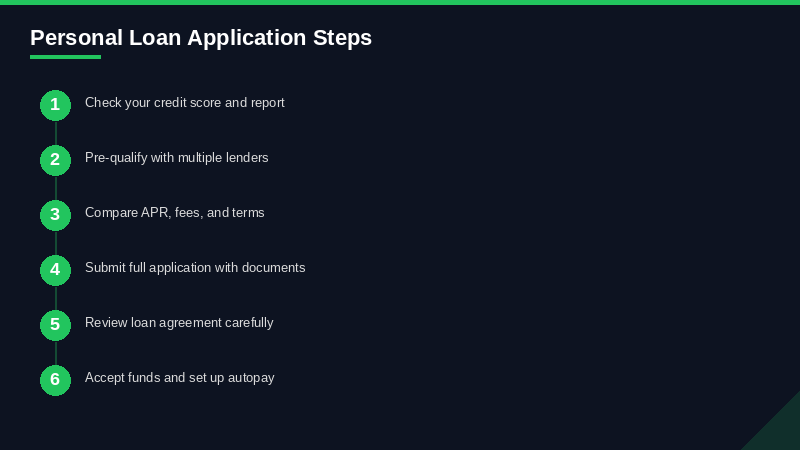
If you take a bad-credit loan, use it. Not just for the immediate need — use it as an intentional credit-building instrument.
All six lenders on this list report to all three major bureaus. Consistent on-time payments build positive history that FICO weights heavily. The improvement timeline is real:
Months 1-6: minimal score change, too early for history to accumulate Months 7-12: 10-20 point improvement possible if you've been perfect on payments Months 13-24: 20-40 point improvement range for borrowers who started at 580-620 Months 25+: potential to reach 650-680 territory depending on other factors
What else to do simultaneously: - Get a secured credit card (Discover it Secured, Capital One Secured Mastercard) — use it for one small recurring charge and pay it in full every month - Check your credit reports at AnnualCreditReport.com for errors — inaccurate negative items can be disputed and removed - If you have any collections accounts, investigate pay-for-delete options before paying — paying a collection without getting deletion can sometimes hurt more than help depending on the FICO version - Keep your credit card utilization below 30% — ideally below 10%
In 24 months of consistent behavior, a 580 can realistically become a 640-660. That unlocks Discover, Marcus, maybe even SoFi at reasonable rates. The bad-credit loan is a bridge — treat it like one.