
1How Credit Cards Actually Work
Most people use credit cards every day without understanding the mechanics underneath. That's fine until it isn't — until you're staring at a statement wondering why you owe more than you spent, or why your interest charge doesn't match the APR on your card agreement.
So let's go through the actual plumbing.
Every credit card runs on a billing cycle — typically 28 to 31 days. Your card issuer picks a start date (usually around when you opened the account) and tracks all purchases, payments, and credits within that window. When the cycle closes, they generate your statement. The balance on that statement is what you owe.
Here's where the grace period matters. If you pay your full statement balance by the due date — which is usually 21 to 25 days after the billing cycle closes — you pay zero interest. Zero. The issuer essentially gave you a short-term, interest-free loan. That's the whole game if you're using credit cards correctly.
But the second you carry a balance forward? Grace period gone. Now interest starts accruing on new purchases from the day you make them, not the statement date. A lot of people don't know that part. They carry $500 from last month, pay minimums, make new purchases, and wonder why their balance keeps climbing even though they're spending less.
The math on credit card interest is genuinely ugly. Cards use daily periodic rate — your APR divided by 365 — applied to your average daily balance. So a card with 24.99% APR charges roughly 0.068% per day. On a $3,000 balance that's about $2.05 in interest every single day. $62 a month. $744 a year. And that's before you've added anything new.
Minimum payments are how issuers keep you on the hook. Federal rules require minimums to cover at least 1% of the balance plus interest, or a flat $25, whichever is higher. On a $5,000 balance at 24% APR, your minimum might be $125. Pay only that every month and you're looking at about 17 years to pay off the card and somewhere around $7,000 in total interest. On a $5,000 balance. The math is deliberately brutal.
One more thing people get wrong: the difference between your credit limit and your available credit. Your credit limit is the ceiling. Your available credit is the ceiling minus what you currently owe. Maxing out a card doesn't just mean you can't spend — it tanks your credit utilization ratio, which is one of the biggest factors in your credit score. More on that later.
2Types of Credit Cards (And Who Each One Is Actually For)
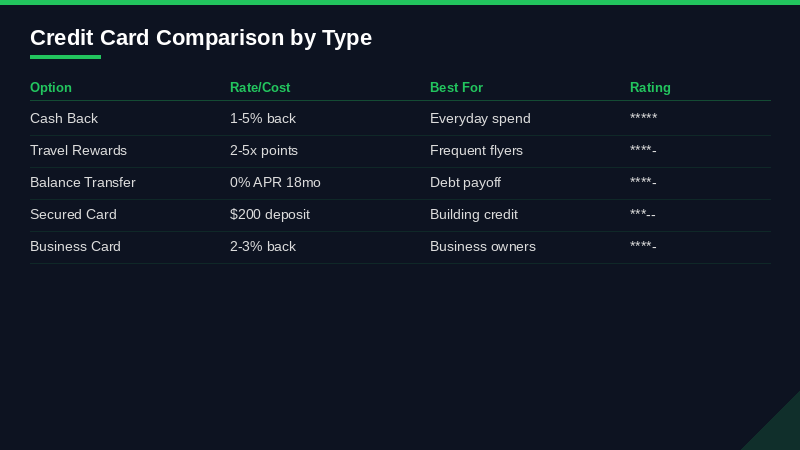
Not all credit cards are built the same. The rewards structure, fees, and perks vary wildly depending on what the issuer is trying to optimize for. Here's every major type, and who should actually be using them.
**Cash Back Cards**
Simplest category. You spend money, you get a percentage back as cash. No portal to navigate, no points to devalue, no category bonuses to track if you don't want to. Flat-rate cards like the Citi Double Cash give you 2% on everything — 1% when you buy, 1% when you pay. Rotating category cards like Chase Freedom Flex or Discover it Cash Back give you 5% in specific categories (grocery, gas, Amazon, restaurants — they rotate quarterly) with 1% on everything else.
Who it's for: people who want simplicity or who spend heavily in predictable everyday categories. Also honestly the best default for anyone not yet optimizing for travel.
**Travel Rewards Cards**
Points and miles instead of cash. The value ceiling is higher — you can routinely get 1.5 to 2+ cents per point when you redeem through transfer partners — but the complexity is also way higher. Chase Ultimate Rewards, Amex Membership Rewards, and Capital One miles all work differently, have different transfer partners, and require different strategies to maximize.
Who it's for: people who travel at least a few times a year and are willing to spend a few hours understanding the redemption options. If you're booking business class flights to Europe, the right travel card can save you $3,000+ on a single trip.
**Balance Transfer Cards**
Built for one specific job: killing existing credit card debt. You move a balance from a high-APR card to a new one offering 0% intro APR — usually for 12 to 21 months — and aggressively pay it down without interest compounding against you. Most charge a transfer fee of 3% to 5%.
Who it's for: anyone sitting on high-interest credit card debt with good enough credit to qualify for a new card. The math is almost always in your favor versus continuing to pay 24% APR.
**Business Credit Cards**
Designed for business expenses. They often have higher credit limits, better rewards on business categories (advertising, shipping, office supplies), and reporting tools that simplify accounting. Some are personal-liability, some are corporate-liability — a distinction that matters a lot.
Who it's for: freelancers, small business owners, anyone with significant business expenses. Even a sole proprietor can qualify if they have business income.
**Secured Cards**
You put down a cash deposit — usually $200 to $500 — that becomes your credit line. The issuer has zero risk because they hold your money. These are designed for people building credit from scratch or rebuilding after damage.
Who it's for: no credit history, recent bankruptcy, or a score below 580. Used correctly for 12 to 18 months, you can graduate to an unsecured card.
**Student Cards**
Low limits, modest rewards, usually no annual fee. Designed for 18-22 year olds who often have limited credit history. Discover it Student Cash Back is a standout — same 5%/1% rotating structure as the regular version, with the first-year cashback match.
Who it's for: obvious. Just make sure you pay it off monthly and don't treat it like free money.
**Luxury / Premium Cards**
High annual fees ($395 to $895+) offset by statement credits, lounge access, hotel status, concierge service, and enhanced rewards. The Amex Platinum at $895/yr, Chase Sapphire Reserve at $795/yr, and Citi Strata Elite at $595/yr all fall here.
Who it's for: people who travel frequently enough to use the lounge access, actually spend in the bonus categories, and will use most of the credits. If you're flying 4+ times a year and stay in hotels, these can pay for themselves several times over. If you're not? Hard to justify.
3Best Credit Cards in 2026 by Category
Here's where we get specific. Real cards, current offers as of March 2026, real numbers.
**Best Overall Travel Card — Chase Sapphire Preferred® Card**
Annual fee: $95. Welcome bonus: 60,000 Ultimate Rewards points after spending $4,000 in the first 3 months (worth roughly $750 through Chase Travel or up to $1,200 transferred to partners). Earning rates: 5x on Chase Travel, 3x on dining and online grocery, 2x on all other travel, 1x on everything else. The $95 fee is easy to justify — the $50 annual hotel credit alone offsets more than half of it, and those 60,000 bonus points are routinely worth over $1,000 for anyone willing to use transfer partners. Best mid-tier travel card on the market. Nothing else at $95 comes close.
**Best Premium Travel Card — Chase Sapphire Reserve®**
Annual fee: $795 (increased in 2025). Welcome bonus: up to 100,000 points + $500 Chase Travel credit after spending $5,000 in 3 months. Earning: 4x on travel and dining via Chase Travel, 10x on hotels and car rentals through Chase Travel. Credits: $300 travel credit, up to $500 on The Edit hotel bookings, $300 dining credit (Sapphire Exclusive Tables), $300 entertainment credit (StubHub/viagogo), DashPass, Apple TV+/Apple Music through mid-2027. The math: if you use all the credits, the effective cost drops to well under $200. More on the break-even analysis in the premium cards section.
**Best Premium Amex Option — American Express® Gold Card**
Annual fee: $325. Earning: 4x at restaurants worldwide (up to $50K/year), 4x at U.S. supermarkets (up to $25K/year), 3x on flights booked directly or through Amex Travel, 1x on everything else. Credits: $120 dining credit ($10/month at participating partners), $120 Uber Cash, $100 hotel credit on Amex Travel bookings. For someone who spends $600+/month on food and restaurants, this card earns faster than almost anything else. The dining credit partially offsets the fee, and Membership Rewards transfer to some exceptional partners — Air France/KLM Flying Blue, ANA, Avianca — for outsized first-class redemptions.
**Best Flat-Rate Cash Back — Citi Double Cash® Card**
Annual fee: $0. Welcome bonus: $200 cash back after $1,500 in purchases in the first 6 months. Earning: 2% on everything (1% at purchase, 1% on payment). This is the simplest, most consistent cash back card out there. No categories to track, no activation required, no spending caps. For anyone who wants to optimize a single card without thinking about it, this is the one.
**Best Rotating Category Cash Back — Chase Freedom Flex®**
Annual fee: $0. Welcome bonus: $200 after $500 in purchases in the first 3 months. Earning: 5% in rotating quarterly categories (up to $1,500/quarter), 3% on dining and drugstores, 5% on Chase Travel, 1% on everything else. This card is a workhorse — especially paired with a Chase Sapphire card, where you can pool the Freedom Flex's cash back as Ultimate Rewards points and boost their value through transfer partners.
**Best No-Annual-Fee Travel Card — Capital One VentureOne Rewards**
Annual fee: $0. Welcome bonus: 20,000 miles after $500 in purchases in the first 3 months. Earning: 1.25x on everything, 5x on hotels and rental cars through Capital One Travel. Low floor, but the no-fee structure makes it a solid starter travel card.
**Best Premium No-Fee-Justified Travel — Capital One Venture X Rewards Credit Card**
Annual fee: $395. Welcome bonus: 75,000 miles after $4,000 in purchases in the first 3 months. Earning: 2x on everything, 5x on flights through Capital One Travel, 10x on hotels and rental cars through Capital One Travel. The kicker: 10,000 bonus miles every anniversary (worth ~$100) plus $300 annual Capital One Travel credit. If you use those two benefits, you're essentially paying $0 net annual fee. Plus Priority Pass access to 1,300+ lounges. This card is bizarrely undervalued.
**Best Balance Transfer Card — Wells Fargo Reflect® Card**
Annual fee: $0. Intro APR: 0% for 21 months on purchases and qualifying balance transfers. Transfer fee: 5% (min $5). For the longest 0% window from a major issuer, this is the pick.
**Best Student Card — Discover it® Student Cash Back**
Annual fee: $0. Earning: 5% in rotating categories (up to $1,500/quarter, activation required), 1% on everything else. First year: Discover automatically matches all cash back earned. No credit score required to apply. Best first credit card for college students.
**Best Secured Card — Discover it® Secured Credit Card**
Annual fee: $0. Minimum deposit: $200. Earning: 2% at gas stations and restaurants (up to $1,000/quarter), 1% everywhere else. Cashback match in first year. Automatic reviews after 7 months to see if you qualify for an unsecured upgrade. Genuinely one of the better secured cards because it earns real rewards while you build.
**Best Business Card — Chase Ink Business Preferred® Credit Card**
Annual fee: $95. Welcome bonus: 90,000 Ultimate Rewards points after $8,000 in purchases in the first 3 months (worth $1,125 through Chase Travel, potentially much more via transfer partners). Earning: 3x on travel, shipping, internet/cable/phone, and advertising on social media/search (up to $150,000/year combined), 1x on everything else. Employee cards at no additional cost. Best business card at the $95 price point, and the 90K bonus is legitimately excellent.
**Best Luxury / Everything Card — American Express® Platinum Card**
Annual fee: $895. Welcome bonus: up to 175,000 Membership Rewards points after spending $12,000 in 6 months (elevated offers available via referral links). Earning: 5x on flights booked directly with airlines or via Amex Travel (up to $500K/year), 5x on prepaid hotels through Amex Travel, 1x on everything else. More on the full break-even math below.
There's the best one for your spending pattern, risk tolerance, and how much complexity you're willing to manage.
4How to Choose a Credit Card (The Actual Decision Framework)
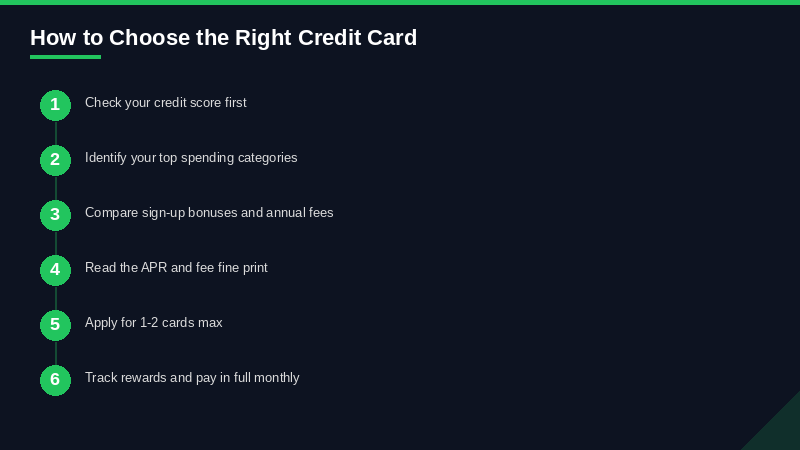
There's no universal best credit card. There's the best one for your spending pattern, risk tolerance, and how much complexity you're willing to manage. Here's how to actually decide.
**Step 1: Audit Your Spending**
Pull three months of bank and existing card statements. Categorize it: dining, groceries, gas, travel, online shopping, everything else. Most people are surprised. The average American household spends about $3,200/year on groceries, $2,400 on dining, and $2,000+ on travel. But your numbers matter, not averages.
If you spend $1,000/month on groceries and restaurants: the Amex Gold's 4x on both is worth $480/year in Membership Rewards at minimum, which at 1 cent each is $480 cash-equivalent — enough to cover the $325 annual fee with room to spare.
If you spend $500/month on everything equally: a flat 2% card like Citi Double Cash earns $120/year with no annual fee. A $95 travel card would need to earn $215 in rewards to break even. Do the math before you get seduced by a big sign-up bonus.
**Step 2: Figure Out Whether You'll Carry a Balance**
Honest self-assessment time. If there's any real chance you carry a balance — even sometimes — rewards cards are probably the wrong play. A 24% APR card will eat any rewards you earn and then some. In that case, look for the lowest APR card you can get, or a 0% intro APR offer to buy yourself time to pay down debt.
**Step 3: Annual Fee Math**
Every annual fee card needs to clear a simple hurdle: the rewards and credits you actually use must exceed the fee. The word "actually" is doing a lot of work there. Amex Platinum's $895 fee can theoretically be offset with $1,400+ in credits — but only if you use all of them. If you don't fly Delta, the $200 airline credit might not apply to your airline. If you don't use Equinox, that credit is worthless to you.
Be conservative. Only count credits you'll definitely use. Then see if the rewards earning on your actual spending clears the remaining fee.
**Step 4: Sign-Up Bonus Math**
Big bonuses look great but have a cost: the minimum spend requirement. Chase Sapphire Preferred wants $4,000 in 3 months for 60,000 points. If you'd naturally spend that anyway, great. If you're forcing purchases you wouldn't otherwise make, you're paying for the bonus.
Also check the card's historical bonus. Chase Sapphire Preferred has offered 80,000 and even 100,000 in the past. If the current offer is lower than historical highs, it might be worth waiting. Doctor of Credit and The Points Guy both track bonus histories.
**Step 5: Ecosystem Considerations**
This matters more than people think. Chase Ultimate Rewards points earned on a Freedom Flex (no annual fee) can be pooled with a Sapphire Preferred or Reserve and transferred to travel partners. That's worth several cents per point more than redeeming for cash. If you're building a card stack, ecosystem compatibility multiplies your returns.
Similarly, Amex Membership Rewards earned on a Gold are more valuable than they look on paper because of high-value transfer partners like ANA, Avianca, and Air France/KLM. A "1x" on some purchases becomes a 3-4 cent/point return if you know where to redeem.
**The Quick Decision Tree**
— Carrying debt right now? Balance transfer card first, everything else second. — Credit score under 640? Secured card to rebuild, then reassess in 12 months. — Hate complexity, want simplicity? Citi Double Cash (no fee) or PayPal Cashback Mastercard. — Travel 4+ times a year, willing to learn the system? Chase Sapphire Preferred to start. — Heavy food/restaurant spender? Amex Gold earns more in those categories than anything. — Already have Sapphire Preferred and want to upgrade? Venture X is the best mid-premium option.
5Credit Card Rewards Deep Dive: Points, Miles, and Cash Back
This is where most guides gloss over the actually important stuff. Let's get into it.
**Cash Back: Simple, Reliable, Usually Undervalued**
Cash back is worth exactly what it says — 2% on Citi Double Cash means 2 cents per dollar. No conversion, no portal, no waiting for sweet spot redemptions. The ceiling is lower than points, but the floor is also reliable. You're never going to squeeze 3 cents per point out of cash back.
Best flat rates right now: Citi Double Cash (2%), PayPal Cashback Mastercard (3% at PayPal/Venmo merchants, 1.5% elsewhere — underrated), Wells Fargo Active Cash (2% flat). For rotating categories: Chase Freedom Flex and Discover it both hit 5% in quarterly categories.
**Points: The High Ceiling, The Learning Curve**
Membership Rewards (Amex), Ultimate Rewards (Chase), ThankYou Points (Citi), and Capital One miles all function similarly — they're a proprietary currency you can cash out at low value or transfer to partner programs at potentially much higher value.
The baseline redemption rate — cash back, gift cards, statement credits — is usually 0.6 to 1 cent per point. That's not great. The magic happens in transfers.
Chase Ultimate Rewards transfer at 1:1 to 14 airline and hotel partners: United MileagePlus, Southwest Rapid Rewards, British Airways Avios, Air France/KLM Flying Blue, Singapore Airlines KrisFlyer, Virgin Atlantic Flying Club, Iberia Plus, Aer Lingus AerClub, Air Canada Aeroplan, Emirates Skywards, World of Hyatt, IHG Rewards, Marriott Bonvoy.
That list matters. World of Hyatt is one of the best hotel loyalty programs on earth. Park Hyatt Paris rates that retail for $900/night can be booked for 25,000-35,000 Hyatt points. Those points came from Chase. At 1:1 transfer. That's potentially 3-4 cents per point.
Amex Membership Rewards don't transfer to Hyatt, which is a meaningful gap. But they do transfer to ANA (All Nippon Airways) — and ANA redemptions for first/business class flights to Japan are legendarily underpriced. Transferring 88,000 Amex points to ANA and booking a round-trip first class Tokyo flight that would otherwise cost $8,000-$12,000 cash... that's 9-13 cents per point.
Obviously most people aren't flying first class to Tokyo every year. But the point is the ceiling on points is legitimately 4-10x higher than cash back when used correctly.
**Miles: Airline-Specific Currency**
Airline co-branded cards (Delta SkyMiles Reserve, United Explorer, Southwest Priority) earn miles that only work with that airline. Less flexible than transferable points. The upside is perks: free checked bags, priority boarding, companion certificates, upgrade priority. If you fly one airline almost exclusively and have status or want it, the co-branded card makes sense. Otherwise, transferable points are almost always better.
**Redemption Values: What Points Are Actually Worth**
Here's a rough value table based on typical redemptions (not best-case scenarios):
| Currency | Cash Out | Portal Booking | Transfer Partners (avg) | Best Transfers | |---|---|---|---|---| | Chase Ultimate Rewards | 1¢ | 1.5¢ (CSR) | 1.5-2¢ | 3-4¢+ (Hyatt, Avios) | | Amex Membership Rewards | 0.6¢ | 1¢ | 1.5-2¢ | 4-10¢+ (ANA, Air France) | | Capital One Miles | 1¢ | 1¢ | 1-1.5¢ | 1.5-2¢ | | Citi ThankYou Points | 0.5-1¢ | 1¢ | 1.5-2¢ | 2-3¢+ (Turkish Miles&Smiles) | | Cash Back | 1¢ | N/A | N/A | 1¢ |
The gap between "cash out" and "best transfers" on Amex/Chase is the entire argument for using travel cards over cash back for high spenders.
**Transfer Partners — The Ones Actually Worth Knowing**
Chase → World of Hyatt: 1:1. Best hotel program for value. Park Hyatts, Alila properties, and Andaz hotels all bookable for points.
Amex → Air France/KLM Flying Blue: 1:1. Frequent Flash Sales make transatlantic flights bookable for 20,000-30,000 miles one-way in business class. Regularly.
Amex → Avianca LifeMiles: 1:1. Star Alliance redemptions at low rates, no fuel surcharges on partner awards. Complicated but valuable.
Chase → British Airways Avios: 1:1. Avios are distance-based, so short-haul flights on American (a BA partner) can be booked for 7,500-10,000 Avios round-trip.
Capital One → Turkish Airlines Miles&Smiles: 1:1. Star Alliance redemptions at insane prices — business class NYC to Tokyo for 45,000 miles one-way. The best redemption in the Capital One ecosystem by a wide margin.
6Best Sign-Up Bonuses Available Right Now
Sign-up bonuses are the fastest way to accumulate points. Done right, a single application can be worth $750 to $2,000+ in travel value. Here's what's currently available as of March 2026.
**Chase Sapphire Preferred® — 60,000 Ultimate Rewards Points**
Spend $4,000 in the first 3 months. Worth $750 as Chase Travel credit. Worth $900-$1,200+ transferred to travel partners. Minimum spend is reasonable, annual fee is $95, and this is almost certainly the best mid-tier travel bonus available. The card also comes with primary rental car insurance and trip cancellation protection — underrated benefits.
Note on timing: Chase has the 5/24 rule — if you've opened 5+ credit cards across all issuers in the past 24 months, Chase will deny you. Know where you stand before applying.
**Chase Sapphire Reserve® — 100,000 Points + $500 Travel Credit**
Spend $5,000 in the first 3 months. 100,000 points are worth $1,500 through Chase Travel at 1.5¢/point, or up to $3,000+ transferred strategically. The $500 travel credit is separate and comes as a statement credit on travel purchases within the first year. That's a combined first-year value easily north of $2,000 before you earn a single point from regular spending. Annual fee: $795.
If you're going to apply for the Reserve, timing matters. Sign up before a big travel spend. Don't let the $5,000 minimum force weird purchases.
**American Express® Gold Card — 60,000-100,000 Membership Rewards Points**
Public offer is typically 60,000-80,000 points after $6,000 in 6 months. Better offers (90,000-100,000) sometimes available via referral links or targeted mailers. At 1¢ baseline that's $600-$1,000, and at better transfer values that number climbs. Annual fee: $325. The dining and grocery earning rates (4x on both) mean you start recouping quickly after the bonus.
**American Express® Platinum Card — Up to 175,000 Membership Rewards Points**
Public offer is 80,000 points after $8,000 in 6 months. Elevated offers via referral links go up to 125,000-150,000 points. The absolute best offer — 175,000 points after $12,000 in 6 months — appears periodically. At even 1.5¢/point, 175,000 points are worth $2,625. At ANA or other premium partner value, potentially far more. Annual fee: $895. High fee, high ceiling.
**Capital One Venture X — 75,000 Miles**
Spend $4,000 in 3 months. 75,000 miles at 1¢ each equals $750 cash value. Transfer to Turkish Airlines and apply to Star Alliance business class and that number grows significantly. Annual fee: $395, offset by 10,000 anniversary miles + $300 travel credit. Net effective fee is basically $0 if you use both benefits.
**Chase Ink Business Preferred® — 90,000 Ultimate Rewards Points**
Spend $8,000 in 3 months. Business card, so doesn't count toward Chase 5/24 rule (it doesn't add to your count, but you still need to be under 5/24 to get approved). 90,000 points worth $1,125 at minimum through Chase portal. Annual fee: $95. Best business card bonus on the market at this spend level.
**Citi Strata Elite — 75,000 ThankYou Points**
Spend $4,000 in 3 months. Annual fee: $595. New flagship premium card from Citi with $1,425 welcome offer value (per Citi marketing), Priority Pass, American Airlines Admirals Club lounge passes, and enhanced earning rates. Newer card, but Citi ThankYou points are transferable to some excellent partners, particularly Turkish Airlines Miles&Smiles.
**Important Rules on Bonuses**
You can't get a sign-up bonus on a card you've held before (or held recently). Chase: no Sapphire bonus if you received one in the past 48 months. Amex: once-in-a-lifetime rule on welcome offers (they may show a popup warning if you're ineligible). Capital One: 6-month wait between applications for most cards.
Track your eligibility. Doctor of Credit has an excellent list of all current offers and historical highs — if the current offer is below historical average, it's worth waiting a few months.
7Balance Transfer Strategies: The Math Actually Works
If you're carrying credit card debt at 20-30% APR, a balance transfer is probably the single highest-ROI financial move available to you right now. Let's run the numbers.
**How It Works**
You apply for a card offering 0% intro APR on balance transfers. You get approved. You request a transfer of your existing balance (up to your new credit limit) to the new card. The old balance moves, and now you have 0% APR for however long the intro period lasts — usually 12 to 21 months.
During that window, every dollar you pay goes directly to principal. No interest eating your payments. On a $5,000 balance at 24% APR, that's roughly $1,200 in interest saved over 12 months, or $2,100 over 21 months — minus the transfer fee.
**The Transfer Fee Math**
Almost all balance transfer cards charge a fee: typically 3% to 5% of the amount transferred. On $5,000 at 5%, that's $250 upfront. Still a no-brainer versus $2,100 in interest. But it matters for smaller balances or shorter windows.
Rule of thumb: if you can pay off the balance before the 0% period ends, the transfer fee is almost always worth it. The exception is Citi Simplicity® — it sometimes offers a $0 transfer fee for transfers made in the first 4 months, which is genuinely exceptional for large balances.
**Best Balance Transfer Offers Right Now**
| Card | 0% Period | Transfer Fee | Annual Fee | |---|---|---|---| | Wells Fargo Reflect® | 21 months | 5% (min $5) | $0 | | Citi Simplicity® | 21 months | $0 (first 4 months)* | $0 | | Citi® Diamond Preferred® | 21 months | 3-5% | $0 | | Chase Slate Edge℠ | 21 months | 3% intro, then 5% | $0 | | Discover it® Balance Transfer | 18 months | 3% | $0 | | Chase Freedom Flex® | 15 months | 3% | $0 |
*Citi Simplicity 0% transfer fee offer comes and goes — verify current terms before applying.
**The Payoff Plan**
Here's the only way this works: divide the transferred balance by the number of months in your 0% window. Pay that amount every single month. If your 0% period is 21 months and you transferred $6,300, that's $300/month to zero out the balance before interest kicks in.
Set up autopay. Put it in your budget. Treat it like rent.
What kills people: they do the transfer, pay minimums, and run out the 0% clock with $2,000 still sitting there — then get hit with deferred interest (which some cards charge retroactively) or the standard high APR on the remaining balance. This is not a win. This is how you end up in the same place.
**What Not to Do**
— Don't use the new card for new purchases during the 0% period. Some cards apply payments to the 0% balance first, leaving new purchases to accrue interest at the standard rate. — Don't miss a payment. One missed payment can end the 0% promo period immediately on some cards. — Don't transfer to a card with the same issuer. Chase won't let you transfer a Chase balance to another Chase card. Same for most major issuers. — Don't apply for a balance transfer card right before applying for a mortgage. New credit inquiries temporarily drop your score.
**After the 0% Period**
If you haven't paid off the balance by the end of the intro period, you have two options: accept the new higher APR on the remaining balance, or do another balance transfer to a new card. The second transfer works — you can repeat this — but each new application is a hard inquiry, and your credit history with balance transfers can make approval harder over time. The real answer is to be aggressive enough during the 0% window that you don't need to.
Fees are where issuers quietly extract billions from cardholders who aren't paying attention.
8Credit Card Fees Explained
Fees are where issuers quietly extract billions from cardholders who aren't paying attention. Here's every major fee, what it actually costs, and when it's avoidable.
**Annual Fee**
The most visible fee. Ranges from $0 (most cash back and starter cards) to $895 (Amex Platinum). An annual fee is only worth paying if the rewards, credits, and benefits you actually use exceed the fee. Common mistake: people carry a $95 or $395 annual fee card for years on autopilot without doing the math on whether it still makes sense for their current spending.
Set a calendar reminder each year to evaluate whether to keep, downgrade, or cancel. Most issuers let you downgrade to a no-fee version without closing the account — preserving your credit history and credit limit.
**Foreign Transaction Fee**
Usually 1% to 3% of every purchase made in a foreign currency or processed through a foreign bank. Chase, Amex, and Capital One generally waive these on travel cards. Discover waives them on all cards. Bank of America and some store cards still charge them.
If you travel internationally more than once a year and you're using a card with a 3% foreign transaction fee, you're throwing money away. Get a travel card. The Schwab Debit Card and Chase Sapphire lineup both have $0 foreign transaction fees and are the standard recommendation.
**Cash Advance Fee**
This one's predatory. Most cards charge 5% (min $10) for cash advances. Worse: there's no grace period. Interest starts accruing immediately, usually at a higher rate than your purchase APR (often 29.99% or higher). And every ATM transaction on a credit card counts as a cash advance.
Don't use credit cards for cash advances. Ever. It's that simple. If you're in a pinch, call your bank and use a checking account.
**Balance Transfer Fee**
Already covered above — typically 3% to 5% of the transferred amount. Even with the fee, it's usually worth it versus continuing to pay high APR on existing debt.
**Late Payment Fee**
Up to $41 per instance under current CFPB rules (though recent regulatory changes have attempted to cap this lower — check current status). But the fee itself isn't the real damage. A payment more than 30 days late gets reported to credit bureaus and can drop your score by 100+ points. And if you have a 0% promo APR, one late payment can void it immediately.
Set autopay to at least the minimum payment. You don't have to pay in full automatically (though you should), but missing a payment is always avoidable.
**Overlimit Fee**
Less common now — issuers are required to get your opt-in to allow over-limit transactions, and most people haven't opted in. If you somehow have: up to $41/occurrence. Just don't opt in.
**Returned Payment Fee**
Your payment bounces because of insufficient funds in your checking account. Up to $40. Also triggers a penalty APR on some cards, which can be 29.99% or higher permanently (or until you make 6+ consecutive on-time payments). Avoid this by not scheduling credit card payments you can't actually cover.
**Statement of Fees You Should Never Pay**
| Fee | How to Avoid | |---|---|n| Annual fee | Only carry cards worth their fee; downgrade rather than cancel | | Foreign transaction | Use a travel card with no FX fees abroad | | Cash advance | Never use credit cards for cash | | Late payment | Autopay minimum payment, always | | Overlimit | Don't opt in | | Returned payment | Don't schedule payment if checking account is low |
9How Credit Cards Affect Your Credit Score
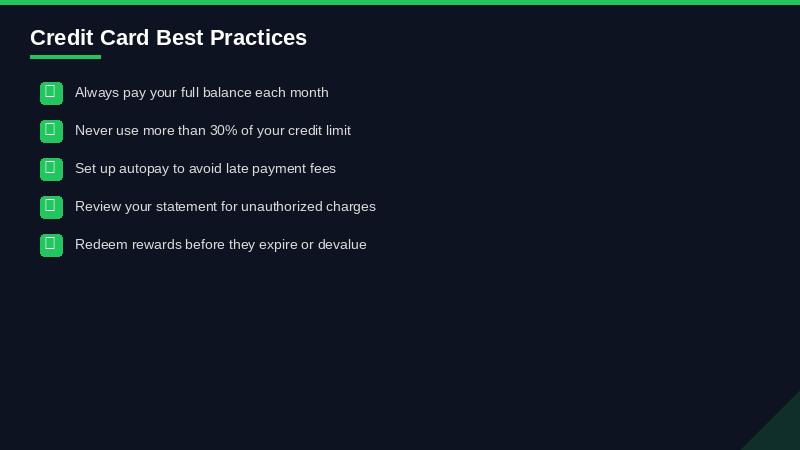
Credit scores are built on FICO's scoring model (used in 90%+ of lending decisions). The formula has five components, and credit cards touch almost all of them.
**Payment History — 35% of Your Score**
Biggest factor by far. A single missed payment (30+ days late) can drop your score 50-100+ points and stays on your report for 7 years. An on-time payment every month, for years, is the single most powerful thing you can do for your credit.
Autopay the minimum at minimum. Pay the full balance whenever possible. Never miss.
**Credit Utilization — 30% of Your Score**
This is the ratio of your current credit card balances to your total credit limits. $1,000 balance on a $5,000 limit = 20% utilization. FICO measures this both per-card and across all cards.
Conventional wisdom says keep utilization under 30%. More aggressive optimization says under 10% for max score impact. The key insight: utilization is measured on the statement date, not the payment date. So even if you pay in full every month, if your statement shows a high balance, your score sees high utilization.
Fix: pay down balances before the statement closes, not just by the due date.
Also: opening new credit cards increases your total available credit, which — assuming your balances stay the same — lowers your utilization ratio. This is why well-managed cardholders with 5+ cards often have higher credit scores than people with 1-2 cards maxed out.
**Length of Credit History — 15% of Your Score**
Average age of all accounts and age of your oldest account. Opening new cards lowers your average age. This is why you shouldn't open 5 new cards in a year even if you can get the bonuses — each new account pulls down the average.
Also: don't close old cards just because you're not using them. A closed card eventually disappears from your report (good accounts stay 10 years, bad accounts 7 years). Keeping a no-fee card open and occasionally using it preserves your history.
**Credit Mix — 10% of Your Score**
Having both revolving credit (credit cards) and installment credit (mortgage, car loan, student loan) is better than having only one type. Minor factor, but it's there.
**New Credit / Hard Inquiries — 10% of Your Score**
Every time you apply for a credit card (or any credit), the issuer runs a hard pull on your credit report. This drops your score by roughly 5-10 points temporarily — usually recovers within a few months.
Don't apply for multiple cards in a short period if you're about to apply for a mortgage or car loan. Inquiries cluster and can be flags for lenders.
**Practical Score Impact Table**
| Action | Score Impact | Duration | |---|---|---| | Missed payment (30+ days) | -50 to -100 | 7 years on report | | Maxed out card (90%+ utilization) | -20 to -50 | Until paid down | | New card application (hard pull) | -5 to -10 | Recovers in 3-6 months | | Opening new card (lowers avg age) | -5 to -20 | Permanent until history grows | | Paying balance to $0 | +20 to +50 | Immediate at next report | | 12 months on-time payments | +30 to +80 | Cumulative | | Closing old card | -5 to -20 | Until avg age recovers |
10Credit Card Security: What Actually Protects You
Credit cards have better fraud protection than almost any other payment method. But most people don't fully understand what they're protected against or how to make the protection work.
**Zero Liability Policies**
Visa, Mastercard, Discover, and Amex all have zero liability policies — if someone fraudulently uses your card, you're not responsible for those charges. This is federal law (Fair Credit Billing Act) plus the issuer's own policy. Debit cards have weaker protection: report fraud within 2 days for zero liability, 2-60 days for max $500 liability, after 60 days you might be out everything.
This alone is a strong argument for using a credit card (paid in full monthly) instead of a debit card for everyday purchases.
**EMV Chip vs. Contactless vs. Magnetic Stripe**
Magnetic stripe: worst security. Data is static and easily cloned. Skimmers at gas stations and ATMs capture stripe data constantly. If you're swiping a card instead of inserting or tapping, you're more vulnerable.
EMV chip: generates a unique transaction code for each purchase. Even if someone captures the data, they can't use it for another transaction. Massive improvement over stripe. Standard in the US since 2015.
Contactless (NFC/tap): same security as EMV chip with the convenience of tapping. Each transaction generates a unique code. Not meaningfully less secure than inserting the chip.
Prioritize: tap > chip > swipe.
**Virtual Card Numbers**
Amex, Capital One, and Citi all offer virtual card number generation — a temporary card number tied to your real account that you can use for online purchases. If the virtual number is compromised, you delete it and generate a new one. Your real account number is never exposed.
For any subscription service or one-time online purchase you're uncertain about, use a virtual number. It takes 30 seconds and makes fraud cleanup trivial.
**Fraud Alerts and Credit Freezes**
Fraud alert: a flag on your credit report that tells lenders to take extra verification steps before extending credit in your name. Free to place, lasts 1 year, you can extend it. Call one bureau (Equifax, Experian, or TransUnion) — they're required to notify the others.
Credit freeze: locks your credit report so no new credit can be opened without you manually lifting the freeze. Free since 2018 (law changed). Strongest protection against identity theft. Doesn't affect existing accounts. Takes a few minutes to lift when you need to apply for something.
If you're not actively applying for credit, a credit freeze costs you nothing and protects against a significant category of fraud.
**What to Do When Your Card Is Compromised**
Report immediately. Most issuers have 24/7 fraud lines. Once reported, the issuer issues a new card number and reverses fraudulent charges. Keep notes of everything — dates, amounts, merchant names — in case there's a dispute.
Credit card companies are incentivized to make fraud resolution easy because they want you to keep using the card. In most cases, disputed charges are reversed provisionally while the investigation happens.
11Premium Cards Deep Dive: Amex Platinum and Chase Sapphire Reserve Break-Even Analysis
These two cards generate more debate than anything else in the credit card world. The fees are high enough to make reasonable people nervous. Let's actually run the numbers.
**American Express® Platinum Card — $895/year**
The credits (2026 structure): - $200 airline fee credit (select one airline, covers fees, change fees, seat upgrades — not tickets generally) - $200 hotel credit (Fine Hotels + Resorts or The Hotel Collection via Amex Travel, prepaid bookings) - $200 Uber Cash ($15/month + $35 in December, effective only in Uber app) - $120 streaming credit ($10/month on eligible services) - $100 Saks Fifth Avenue credit ($50 January-June, $50 July-December) - $199 CLEAR Plus credit - Equinox credit (up to $300) - Walmart+ credit (up to $155) - Lounge access: Centurion Lounges (best), Delta Sky Clubs (when flying Delta), Priority Pass, Plaza Premium, Airspace — roughly 1,400+ lounges worldwide
Maximum credit value if you use everything: ~$1,674+. Effective net cost: negative if you extract full value.
Real-world extract (what most people actually use): airline fees ~$100 (many people don't fly airlines that have seat upgrade fees), hotel credit ~$200 (requires booking through Amex Travel, which sometimes costs more than direct), Uber Cash ~$180 (only in app, doesn't work everywhere), CLEAR ~$150 (if you travel through CLEAR airports regularly), Saks ~$100 (only if you shop there).
Conservative real-world value: $700-$900 in credits used. That puts the net cost at $0-$200 for a frequent traveler, or $400-$895 for someone who doesn't use the credits.
The earning rate: 5x on flights and prepaid hotels through Amex Travel. On $10,000/year in flights, that's 50,000 Membership Rewards — worth $500-$1,000+ depending on redemption. But the card earns 1x on basically everything else, which is a significant weakness. The Amex Gold is a much better everyday earner.
Who should get the Platinum: frequent business travelers who actually use Centurion Lounges (they're genuinely excellent), people flying Delta (Sky Club access is huge), people who use CLEAR regularly, and people who can actually extract $800+ in annual credits. Not a great card if you're primarily a domestic leisure traveler who doesn't use the lounge networks.
**Chase Sapphire Reserve® — $795/year**
The credits (2026 structure): - $300 travel credit (automatic statement credit on any travel purchase, very broad definition) - $500 on The Edit hotel bookings (up to $250 twice/year — Chase's luxury hotel program) - $300 dining credit (Sapphire Exclusive Tables restaurants, $150/semester) - $300 entertainment credit (StubHub/viagogo, $150/semester) - DashPass membership (~$120 value) - Apple TV+ and Apple Music (through June 2027, ~$288/value)
Maximum credit value: ~$1,800+. After $795 fee, net value before earnings: +$1,000+ in pure credits if you extract all of them.
Real-world caveat: the $500 on The Edit requires booking through Chase's portal and the participating hotels tend to be expensive. The $300 dining credit requires eating at Sapphire Exclusive Tables restaurants specifically — not all restaurants. The entertainment credit requires buying through StubHub.
Conservative real-world value: $300 travel (almost everyone uses this) + $200 dining if you're in a city with participating restaurants + $150 DashPass + $100 Apple services = ~$750 in credits. Net cost: ~$45.
The earning rate: 4x on dining and travel (via Chase), 10x on hotels/cars through Chase. Plus the $5,000 minimum spend welcome bonus of 100,000 points + $500 credit = ~$2,000+ in first-year value.
**Head to Head**
| | Amex Platinum | Chase Sapphire Reserve | |---|---|---| | Annual fee | $895 | $795 | | Best credits | Centurion Lounges, CLEAR, airline fees | Travel credit ($300, broad) | | Earning strength | 5x flights, 1x everything else | 4x travel/dining, 10x Chase hotel/car | | Transfer partners | 20 airlines + hotels | 14 airlines + hotels (includes Hyatt) | | Lounge access | Centurion + Delta + 1,400 | Priority Pass + Sapphire (new) | | Best for | Heavy flyer using lounges | Well-rounded traveler, hotel points |
For most people, the Chase Sapphire Reserve wins on flexibility. The $300 travel credit is automatic and requires no specific merchant. The Hyatt transfer partnership is uniquely valuable. The earning rate on dining is strong.
The Amex Platinum wins for the specific person who flies frequently through Centurion Lounge airports (JFK, LAX, DFW, SFO, etc.), flies Delta and wants lounge access, and will actually use the more restrictive credits. Centurion Lounges are legitimately good — full bar, real food, not the sad Priority Pass setup. If you're there twice a month, the Platinum pays for itself on lounges alone.
They're things happening to millions of cardholders right now.
12Credit Card Mistakes That Cost People Real Money
These aren't exotic mistakes. They're things happening to millions of cardholders right now.
**The Minimum Payment Trap**
Already did the math above but it's worth repeating: paying only the minimum on a credit card balance is one of the most expensive financial decisions most households make. A $5,000 balance at 24.99% APR, paid at minimum monthly, takes 17+ years and costs over $7,000 in interest. The bank tells you the minimum because it's in their interest, not yours.
If you're carrying a balance, pay as much as you possibly can above the minimum. Even an extra $50/month makes a measurable difference.
**Cash Advances**
Touched on this in fees but it deserves emphasis: the combination of 5% upfront fee, no grace period, and 29.99% APR makes credit card cash advances one of the most expensive forms of short-term borrowing that exists. The only thing more expensive is payday loans. Don't do it.
**Missing Payments by Days**
People sometimes pay late because they forgot or their checking account was low. One day late: late fee (up to $41). Thirty-plus days late: credit report damage that lasts 7 years. This is avoidable with $0 effort — set autopay for the minimum. You can always pay more manually. But the autopay ensures you never hit 30 days.
**Closing Old Cards**
When you get a new, better card, closing the old one feels intuitive. It's usually a mistake. Closing a card: reduces your total available credit (increasing utilization), removes the account's contribution to average credit age over time, and can trigger annual fee if you cancel after the fee posts.
Instead: downgrade to a no-fee version of the same card (many issuers have one). Keeps the credit line open, keeps your history, $0 cost.
**Paying Annual Fees Without Reviewing the Card**
People auto-renew $695 and $895 annual fee cards for years without asking whether the card still earns its keep. Life changes: you travel less, move to a city without a Centurion Lounge, change your spending patterns. Do the math every year.
**Chasing Sign-Up Bonuses Without a Plan**
Card churning — opening cards purely for bonuses and then closing them — can work, but it requires rigor. Opening too many cards too fast: triggers Chase 5/24, damages your average account age, and can lead to denials on cards you actually want. Have a plan. Know which cards you want, in what order, and what the rules are for each issuer.
**Carrying a Balance on a Rewards Card**
This is the math that kills the case for rewards cards when you have debt. A 2% cash back card earning $200/year on $10,000 of spending sounds great — until you realize you're paying $1,000-$2,500/year in interest on a $5,000 balance. The rewards don't compensate. Pay off the balance first, then optimize for rewards.
**Using Full Credit Limits Right Before a Major Loan Application**
If you're applying for a mortgage, car loan, or any major financing in the next 3-6 months: keep your credit card utilization low. Don't suddenly charge $8,000 to a card right before closing on a house. The lender pulls your credit again right before closing. A spike in utilization can trigger a re-underwriting or rate change.
**Forgetting About Statement Credits**
Premium cardholders leave enormous value on the table every year by not using credits they're paying for. The $200 Uber Cash on Amex Platinum. The $300 dining credit on Sapphire Reserve. The $120 Amex Gold dining credit that's $10/month. Track your credits. Many issuers have apps or dashboard views showing credit status.
Set a quarterly reminder. It takes five minutes to check. The credits are already baked into the annual fee you paid.
13Credit Cards for Different Life Stages
The best credit card isn't universal — it depends on where you are in life and what your finances look like.
**Students and First-Time Cardholders (18-22)**
Goal: build credit history, learn to use credit responsibly, earn modest rewards without complexity.
Best options: Discover it® Student Cash Back ($0 fee, 5%/1% rotating, cashback match in year 1), Capital One Quicksilver Student (1.5% flat, $0 fee), secured cards if you can't get approved for unsecured.
Rules for this stage: one card only. Pay in full every month. Keep utilization under 20%. Don't increase your limit just because they offer it. Use the card for things you'd already buy — groceries, gas, subscriptions — not for treats you can't afford.
After 12-18 months of responsible use: you'll have a score in the 680-720 range and can upgrade to a more rewarding card.
**First Real Job, Building Credit (22-28)**
Goal: maximize rewards on real spending while building score for future mortgage/car loan.
Best picks: Chase Freedom Unlimited ($0 fee, 1.5% flat + 3% dining + 5% Chase Travel — great gateway card into the Chase ecosystem), Citi Double Cash (2% flat, simple). Then add Chase Sapphire Preferred at $95 once you want to optimize travel.
This is also when you should start tracking your credit score monthly. Creditkarma, Experian app, or through your card issuer's app (most offer free FICO or VantageScore now).
**Families and High Household Spending (28-45)**
Goal: maximize return on the categories families actually spend heavily in: groceries, restaurants, gas, travel.
This is the golden zone for the Amex Gold — 4x on groceries and restaurants covers a huge chunk of family spending. A family spending $800/month on groceries and $400 on dining earns 57,600 Membership Rewards points annually on those categories alone.
If you also travel as a family: Chase Sapphire Preferred or Reserve for the primary travel card, Chase Freedom Flex for rotating category 5%, Amex Gold for food. Three-card setup, all synergistic.
**High Earners and Frequent Travelers (any age)**
Goal: maximize point accumulation, premium travel perks, status benefits.
Full stack: Amex Platinum (lounge access, airline credits, status with hotels) + Amex Gold (eating/groceries) + Chase Sapphire Reserve (Hyatt transfers, dining/travel) + Chase Freedom Flex (rotating 5%). Plus the Ink Business Preferred if you have any business expenses.
Yes, this is aggressive and has ~$2,000+ in annual fees. At $200K-$300K in household spending routed through these cards, the rewards output easily exceeds that. The key is every dollar of spending hitting the optimal card for that category.
**Pre-Retirees and Retirees (55+)**
Goal: simplicity, security, low risk.
Simplicity wins here more than optimization. A Citi Double Cash (2% flat, $0 fee) or Chase Freedom Unlimited for everything. Maybe one travel card if you're doing the retirement travel you've been putting off. The elaborate 5-card setup that makes sense at 35 with a 25-year credit horizon is probably more complex than it needs to be at 65.
Also: fraud monitoring becomes more important. Enable text alerts for every transaction over $1. Consider a credit freeze on bureaus you're not actively using credit with.
14Business Credit Cards: How They Work and Why They're Different
Business credit cards get their own section because the rules are different — in several ways that matter.
**Who Qualifies**
You don't need a corporation or LLC. Sole proprietors, freelancers, Etsy sellers, anyone with business income can apply. You'll use your Social Security Number and be personally liable for the debt. If you have an EIN, use it — but SSN works too for most small business applications.
Issuers ask for business name, type, years in business, and annual revenue. For small operations, be honest about revenue — issuers understand that early-stage businesses have modest income. The underwriting is more flexible than you'd think.
**How They Differ from Personal Cards**
The Consumer Financial Protection Bureau's rules (CARD Act protections) don't apply to business cards. This means: — Issuers can change terms with less notice — Penalty APR can be applied more freely — There's no requirement to apply payments to highest-APR balances first
This matters if you carry a balance. Business card debt is less regulated than personal card debt. Use business cards the same way you should use personal ones: pay in full monthly.
On the flip side, business cards typically don't report to your personal credit bureaus — only to business credit bureaus (Dun & Bradstreet, Equifax Business). Chase Ink cards are an exception — they do pull from personal credit and may report some negative activity to personal bureaus. Know this before applying.
**Best Business Cards 2026**
**Chase Ink Business Preferred® ($95/year)**: Best overall. 90,000 point welcome bonus after $8,000 spend. 3x on travel, shipping, internet/phone/cable, and social media/search advertising (up to $150K combined). Points are full Chase Ultimate Rewards, transferable to Hyatt and other partners. The advertising and shipping categories make this exceptional for online businesses.
**Amex Business Gold Card ($375/year)**: 100,000 point welcome bonus after $15,000 in first 3 months. 4x in your two highest-spend categories each billing cycle (from: advertising, gas, restaurants, transit, electronics, wireless). Automatically optimizes for your spending pattern. Best for businesses with concentrated spend in a couple of Amex's covered categories.
**Capital One Spark Cash Plus ($150/year)**: 2% cash back on everything, no cap. If your business spending doesn't fit neatly into bonus categories and you don't want to deal with points, this is the cleanest option. $1,000 welcome bonus ($500 after $5K, $500 after $50K in first 6 months).
**Chase Ink Business Cash ($0/year)**: 5% on office supplies and internet/cable/phone (up to $25K/year), 2% on gas and restaurants, 1% elsewhere. No annual fee, solid bonus on telecom categories. Great starter business card.
**American Express Blue Business Cash ($0/year)**: 2% on all purchases up to $50K/year (1% after). Solid no-fee option for moderate business spending.
**The Liability Question**
Most small business cards are personally guaranteed — you're personally on the hook for the debt. Corporate cards (like Amex Corporate, Ramp, Brex) work differently: the company is liable, not the individual. Brex and Ramp have no personal liability requirement at all, but they typically require a business bank account with significant cash balance or investor backing.
For a small business owner, personally guaranteed cards are fine and expected. Just understand that if your business hits trouble, the credit card debt doesn't disappear with it.
**Business Card Reporting and Taxes**
Rewards earned on business cards are generally not taxable income — the IRS treats them as rebates. But any cash bonuses you receive as part of a spending requirement (like a sign-up bonus after meeting a spend minimum) may be treated differently. Consult your accountant; most treat them as non-taxable rebates too but practices vary.
Using a dedicated business card makes expense tracking vastly easier. One statement, one category. At tax time, you have a clean record of deductible business expenses without digging through personal bank statements.