
1What a CD Actually Is (And Why Banks Love Selling Them)
A certificate of deposit is a savings account with a lock. You hand the bank a set amount of money — could be $500, could be $100,000 — and you agree not to touch it for a specific period. Six months, a year, five years, whatever you negotiate. In exchange, the bank pays you a fixed interest rate that's almost always higher than what they'd offer on a regular savings account.
That's the deal. Simple as that.
Banks love CDs because predictable deposits let them make predictable loans. When you lock in for 18 months, the bank can lend your money out knowing exactly when they need to have it back. That certainty is worth something to them — which is why they pay you a premium over a standard savings account where you could theoretically pull everything out tomorrow.
For you, the appeal is the certainty going the other direction. Whatever rate you lock in on day one is what you get. Doesn't matter what happens to interest rates while your money's sitting there. Fed cuts rates three times? Doesn't affect you. HYSA rates drop to 2.8% in six months? Also doesn't affect you. You locked in 4.10% and that's what you're earning.
There's a catch, obviously. Touch that money before the term ends and you pay an early withdrawal penalty — usually somewhere between 90 and 365 days of interest depending on the bank and the term. More on that later.
One more thing worth knowing upfront: CDs are FDIC-insured up to $250,000 per depositor, per institution, per account category. Credit union CDs get equivalent protection through NCUA. So the only way you actually lose money in a CD is if you withdraw early and the penalty exceeds your earned interest (which can happen if you pull out very early on a long-term CD) — or if you're somehow holding more than $250K at a single bank with no co-ownership or beneficiary designations to extend your coverage. Neither of those scenarios is common. The point is: CDs are safe. That's basically their whole identity.
2Current CD Rates in March 2026 — Where Things Actually Stand
Okay let's talk real numbers. Because the national average CD rates are genuinely misleading. The FDIC national average for a 1-year CD is sitting around 1.88% APY right now. That number is dragged down by the big brick-and-mortar banks — Chase, Wells Fargo, Bank of America — which are still paying somewhere between 0.01% and 0.50% on most CDs because they don't need your deposits. They have trillions in assets and no particular incentive to compete for your savings.
The actual competitive landscape? Much better than that average suggests.
Online banks and smaller institutions are still paying in the 4% range on most terms, and if you shop around you can find deals above 4.30% on shorter-term CDs right now. Here's what the top of the market looks like as of mid-March 2026:
**6-Month CDs — Top Rates**
| Bank | APY | Minimum Deposit | |------|-----|------------------| | Newtek Bank | 4.30% | $2,500 | | My eBanc | 4.55% (jumbo) | $100,000 | | Northern Bank Direct | 4.15% | $500 | | Bread Savings | 4.00% | $1,500 | | Marcus by Goldman Sachs | 4.05% | $500 |
**1-Year CDs — Top Rates**
| Bank | APY | Minimum Deposit | |------|-----|------------------| | Newtek Bank | 4.00% | $2,500 | | Marcus by Goldman Sachs | 4.00% | $500 | | Bread Savings | 4.10% | $1,500 | | Synchrony Bank | ~3.90% | $0 | | Ally Bank | ~3.80% | $0 |
**2-Year CDs — Top Rates**
| Bank | APY | Minimum Deposit | |------|-----|------------------| | Bread Savings | 4.10% | $1,500 | | Marcus by Goldman Sachs | 3.90% | $500 | | Synchrony Bank | ~3.85% | $0 |
**3-Year CDs — Top Rates**
| Bank | APY | Minimum Deposit | |------|-----|------------------| | Bread Savings | 4.10% | $1,500 | | Marcus | 3.90% | $500 | | Synchrony | ~3.80% | $0 |
**5-Year CDs — Top Rates**
| Bank | APY | Minimum Deposit | |------|-----|------------------| | Grow Financial FCU | 4.02% (jumbo) | $100,000 | | Bread Savings | ~4.00% | $1,500 | | Marcus | ~3.75% | $500 | | Synchrony | ~3.70% | $0 |
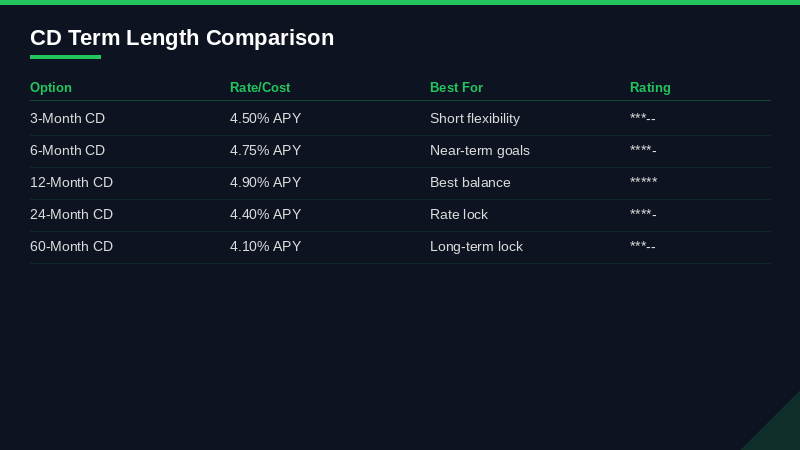
A few things jump out here. First — the yield curve for CDs is weirdly flat right now, almost inverted on shorter terms at some banks. You're getting 4.30% on a 6-month CD at Newtek but only 4.00% on their 1-year. That's unusual. It's happening because markets expect the Fed to cut rates this year, so banks aren't pricing in a big premium for locking up your money longer since they expect to be paying less on deposits in 12-18 months anyway.
Second — the gap between the best online banks and the national average is still enormous. If you're earning 0.10% on a CD at your local bank right now, you're leaving serious money on the table. On $25,000 over a year, the difference between 0.10% and 4.10% is roughly $1,000. That's not a rounding error.
Third — minimum deposits vary a lot. Marcus starts at $500 which is genuinely accessible. Newtek wants $2,500. Jumbo rates require $100K. Know what you're working with before you start comparison shopping.
3Every Type of CD Explained — The Full Taxonomy
There are more CD types than most people realize. The differences actually matter, depending on your situation.
**Traditional CD**
This is the standard product. Fixed rate, fixed term, early withdrawal penalty if you leave early. Ranges from 3 months to 5 years at most banks, occasionally up to 10 years. The longer the term, the higher the rate — usually, though not always in the current environment. This is what most people mean when they say 'CD.'
Best for: People who won't need the money and want the highest guaranteed yield.
**No-Penalty CD (also called Liquid CD)**
Same idea, but you can withdraw early without the penalty — usually any time after the first 6-7 days of funding. The trade-off is that rates are typically lower than a comparable traditional CD. Right now no-penalty CDs are running about 3.50-4.00% APY on 7-14 month terms at banks like Marcus, Ally, and Discover.
This is actually a fascinating hybrid. You get a rate that's often better than a high-yield savings account while retaining almost full liquidity. The downside is that you usually have to withdraw the full balance — no partial withdrawals allowed. And obviously if rate outlooks change and you want to lock in a higher rate somewhere else, you can.
Best for: People who want better-than-HYSA rates but aren't 100% sure they wont need the cash.
**Jumbo CD**
Just a CD with a higher minimum deposit, traditionally $100,000. Used to be that jumbos got meaningfully better rates — that gap has mostly closed now because online banks offer competitive rates with much lower minimums. My eBanc is paying 4.55% on their 6-month jumbo right now, but that's a premium you're paying to access jumbo pricing on a 6-month instrument; the effective yield advantage over a regular CD varies by bank.
Honestly? For most people, a jumbo CD isnt obviously better than putting $100K across two regular CDs at different banks. But some institutional savers and retirees still prefer the simplicity of a single instrument.
Best for: People with $100K+ who want to simplify and/or genuinely get a better rate than available at the standard tier.
**Brokered CD**
This is a CD you buy through a brokerage — Fidelity, Vanguard, Schwab — rather than directly from a bank. The mechanics are a bit different. Instead of opening an account at a bank, you're buying a CD as a fixed income instrument that shows up in your brokerage portfolio alongside your stocks and bonds.
The minimums are usually $1,000, sometimes as low as $100 for fractional CDs. The rates are often competitive — sometimes better than what you'd find shopping direct, because the broker is aggregating demand and the issuing bank offers slightly better terms in bulk.
Key differences vs bank CDs: - Interest is typically paid as simple interest, not compounded. This marginally reduces your effective yield vs the APY comparison. - If you need to exit early, you sell on the secondary market — no fixed penalty, but you could get less than your principal if rates have risen since you bought in. That's a real risk people underestimate. - Brokered CDs are still FDIC-insured, but coverage applies per issuing bank. If you have $400K spread across two brokered CDs both issued by the same bank, you're only covered for $250K total. - You can hold them in a Roth or traditional IRA, which is a genuine advantage.
Fidelity, Vanguard, and Schwab all offer brokered CDs. Rates fluctuate daily, so checking in closer to when you want to buy makes sense.
Best for: Investors who already manage money in a brokerage, want diversification across multiple CD issuers, and don't want to open separate bank accounts everywhere.
**Bump-Up CD**
A traditional CD with one built-in option: you can request a rate bump one time (occasionally twice) if your bank raises its CD rates during your term. Typically a bit lower yield than a standard CD at the same term because you're paying for that option.
These made more sense in 2022 when rates were rising fast. In 2026, with the rate outlook pointing generally downward, the bump-up option is worth less. That said, rates could surprise people — uncertainty about inflation and the labor market is real.
Best for: People who think rates might go up but aren't sure, and want a hedge.
**Step-Up CD**
Similar concept to bump-up, but instead of an on-demand option you choose, the rate increases automatically at predetermined intervals. You might get 3.50% for the first year, 3.75% for the second, 4.00% for the third. The starting rate is lower to compensate for the guaranteed increases.
The math often doesnt work out favorably compared to just buying regular CDs and rolling them over — but the psychological appeal of guaranteed increases has value if youre the type of person who obsesses over whether you 'beat the market' on savings.
Best for: Conservative savers who want built-in rate improvement without having to monitor and manage renewals.
**IRA CD**
A regular CD held inside a traditional or Roth IRA. The CD mechanics are identical — fixed rate, fixed term, early withdrawal penalties — but the tax treatment changes. In a traditional IRA, contributions may be tax-deductible and growth is tax-deferred. In a Roth IRA, contributions are after-tax but qualified withdrawals are completely tax-free.
Note that IRA early withdrawal penalties are a different thing from CD early withdrawal penalties. If you pull money from a traditional IRA before age 59½ you typically owe a 10% penalty on top of ordinary income taxes, separate from whatever the bank charges for breaking the CD.
Bankrate tracks IRA CD rates — Synchrony Bank consistently appears near the top with rates on par with their standard CDs across terms from 3 months to 5 years.
Best for: People with IRA funds sitting in money market or low-yield positions who want to lock in a fixed rate with the existing tax shelter.
**Add-On CD**
A CD that lets you deposit additional funds during the term, not just at open. Pretty rare and usually comes with lower rates. USAA and a few credit unions offer them.
Best for: People who want to save systematically and lock in a rate but expect to have more cash to add over time — think home down payment savings over 18-24 months.
A CD ladder is the answer to a genuine problem: you want the higher rates that come with locking money up, but you also need access to cash periodically and you don't want to bet e...
4Building a CD Ladder — The Strategy, The Math, and the Real Numbers
A CD ladder is the answer to a genuine problem: you want the higher rates that come with locking money up, but you also need access to cash periodically and you don't want to bet everything on today's rate being the best available for the next five years.
The basic idea — you split your money across multiple CDs with staggered maturities. Every year (or every six months), one CD matures and you either use the cash if you need it or roll it into a new long-term CD. Over time, you always have a CD coming due soon and you're always earning the longer-term rate on most of your money.
**Classic 5-Year CD Ladder — $50,000 Example**
Let's say you have $50,000 to invest. Using approximate March 2026 rates:
Year 1 CD: $10,000 at 4.10% → matures in 12 months → earns $410 Year 2 CD: $10,000 at 4.10% → matures in 24 months → earns $836 (compounded) Year 3 CD: $10,000 at 4.10% → matures in 36 months → earns $1,281 Year 4 CD: $10,000 at 4.10% → matures in 48 months → earns $1,745 Year 5 CD: $10,000 at 4.10% → matures in 60 months → earns $2,229
Total earned: approximately $6,501 over the full 5-year period — just on the initial $50K without reinvestment.
But here's where the ladder actually earns its keep. When your 1-year CD matures in 12 months, you roll it into a new 5-year CD. Now your whole ladder is generating 5-year rates (which are typically higher than 1-year rates) while you still have a CD maturing every year. By year five, your entire portfolio is in 5-year CDs, which carry the best rates, but you get liquidity annually.
**The Reinvestment Math Over Time**
If you consistently roll each maturing CD into a new 5-year at whatever the current rate is, and assume rates average out around 4% over the period:
- After 5 years of rolling: Your original $50,000 has earned roughly $10,800 in interest (4% compound on the full amount over 5 years). - After 10 years: Roughly $24,200 in interest on the original principal.
That's not a bad outcome for money that was 'safe' the entire time.
**6-Month Mini Ladder**
Don't need the full 5-year structure? A mini ladder using 3-month, 6-month, 9-month, and 12-month CDs gives you quarterly access to a portion of your cash while still capturing short-term high rates.
On $20,000 split evenly into four $5,000 CDs using current rates: - 3-month at ~3.80%: $5,000 → matures Q3 2026, earns ~$47 - 6-month at 4.30%: $5,000 → matures Q4 2026, earns ~$107 - 9-month at 4.20%: $5,000 → matures Q1 2027, earns ~$157 - 12-month at 4.10%: $5,000 → matures Q2 2027, earns ~$205
Total: ~$516 over 12 months, and you have $5,000 available every quarter if anything comes up.
**Barbell Strategy**
A variation where you skip the middle rungs entirely — half your money goes into very short-term CDs (3-6 months) for flexibility, and the other half goes into long-term (4-5 year) CDs to lock in the best available rates. Nothing in between.
This works well right now because the yield curve for CDs is relatively flat — you're not giving up much by skipping 2-3 year CDs and putting that money at either end.
**Grace Periods Matter**
When a CD matures, most banks give you a grace period — usually 7-10 days — to decide what to do. If you do nothing, the CD auto-renews at whatever rate they're currently offering, which may be significantly different from what you locked in originally. Set a calendar reminder. Seriously. I know three people who accidentally locked in at garbage rates because they forgot to act during the grace period.

5Early Withdrawal Penalties — What They Actually Cost You
This is the section most people skip and then regret later.
Early withdrawal penalties are expressed in 'days of interest' — meaning the bank takes back some of the interest you've earned (and if you haven't earned enough interest yet, they dip into your principal). Here's the breakdown at major banks:
**Early Withdrawal Penalty Comparison Table**
| Bank | Up to 12 months | 12-48 months | 48+ months | |------|-----------------|--------------|------------| | Marcus by Goldman Sachs | 90 days interest | 180 days interest | 270 days interest | | Synchrony Bank | 90 days interest | 180 days interest | 365 days interest | | Ally Bank | 60 days interest | 120 days interest | 150 days interest | | Discover Bank | 6 months interest | 18 months interest | 24 months interest | | Chase Bank | 90 days interest | 150 days interest | 150 days interest | | Citibank | 3 months interest | 3-6 months interest | 6-18 months interest | | Capital One | 3 months interest | 6 months interest | 12 months interest |
Discover is notably harsh on longer terms — 18 months of interest is a real bite if you break a 3-year CD early. Ally is actually one of the more lenient options. Marcus is reasonable across the board.
**What Does This Actually Cost?**
Let's do real math. $10,000 in a 2-year CD at 4.00% APY at Marcus. You need the money after 8 months.
Interest earned in 8 months: ~$267 Early withdrawal penalty (180 days of interest on $10,000 at 4.00%): ~$197 Net interest kept: $267 - $197 = $70
So you still come out ahead — barely. But if you had broken that same CD after only 3 months:
Interest earned in 3 months: ~$100 Penalty (180 days): ~$197 You'd lose $97 of principal. That's how the 'dip into principal' scenario actually works.
**The break-even point is important.** Before you lock money in a long-term CD, figure out: at what point does the penalty stop being a disaster? For a 2-year CD at Marcus, you need to stay in at least 6 months before you'd break even on an early exit. Most financial advisors suggest not locking in a CD longer than you're 90% confident you wont need the money. Not 100% — life happens. But 90%.
**No-Penalty CD as the Alternative**
If you're genuinely uncertain about your cash needs in the next 12 months, the no-penalty CD solves this. Yes, rates are lower — maybe 3.50-3.80% vs 4.10% on a comparable regular CD. But the flexibility is real and the rate is still better than most savings accounts. Think of it as paying ~0.30% in yield for full optionality. That's a reasonable trade if you genuinely might need the money.
6CDs vs. The Alternatives — An Honest Comparison
CDs don't exist in a vacuum. You've got options. Let's actually compare them.
**CDs vs. High-Yield Savings Accounts (HYSA)**
Right now, the best HYSA rates are sitting around 4.50% at banks like UFB Direct and Laurel Road — actually beating some 1-year CD rates. This is unusual. Usually HYSA rates are below CDs because savings accounts are fully liquid and banks discount for that convenience.
The reason HYSA rates look good right now: variable rate products haven't fallen as fast as some banks have dropped their CD rates. That will change. When the Fed cuts rates (and they will, probably 1-2 more cuts this year based on current projections), HYSA rates will drop almost immediately. CD rates will drop too, but only for new CDs — if you're already locked in, you're protected.
**Decision rule**: If you're 100% sure you'll need the money within 3 months, HYSA wins. If you've got 12+ months before you'd need it, locking in a CD at current rates is worth considering seriously given the Fed trajectory.
| Feature | Top HYSA | 1-Year CD | 5-Year CD | |---------|----------|-----------|----------| | APY (best available) | ~4.50% | ~4.10% | ~4.00% | | Rate locked? | No — variable | Yes | Yes | | Early withdrawal penalty | None | 90-180 days interest | 180-365 days interest | | FDIC insured | Yes | Yes | Yes | | Minimum deposit | $0 | $0-$2,500 | $0-$2,500 |
**CDs vs. Treasury Bills (T-Bills)**
T-bills are short-term government debt maturing in 4, 8, 13, 17, 26, or 52 weeks. Current yields on 26-week (6-month) T-bills are running around 4.30-4.50%, and 52-week T-bills are in the 4.00-4.20% range.
The big differentiator nobody talks about enough: T-bill interest is exempt from state and local income taxes. CD interest is not.
This is a genuinely significant advantage if you live in a high-tax state. Let's do the math for someone in California (13.3% state income tax rate, roughly):
CD at 4.10% → after federal (24% bracket) and CA state taxes → effective after-tax yield: ~2.88% T-bill at 4.10% → after federal taxes only → effective after-tax yield: ~3.12%
Same headline rate, but the T-bill puts ~$24 more per $10,000 in your pocket per year after tax. Scale that up to $100,000 and you're talking $240. For $500,000? Over $1,200 per year in pure tax efficiency.
People in no-income-tax states (Texas, Florida, Nevada, Washington) don't get this advantage — T-bills and CDs are roughly equivalent from a tax standpoint.
T-bill logistics: You buy directly through TreasuryDirect.gov (no fees, but the interface is clunky) or through your brokerage. They're auctioned weekly. Easier than it sounds once you set it up.
**CDs vs. Money Market Funds**
Money market funds (not to be confused with FDIC-insured money market accounts at banks) are mutual funds holding short-term debt instruments. Top government money market funds — like Vanguard Federal Money Market (VMFXX) or Fidelity Government Money Market — are currently yielding around 4.20-4.40%.
They're extremely liquid — you can sell any time and get your money the next day. Rates float with short-term rates, same as HYSA. They hold T-bills and government paper, so they get the state-tax exemption benefit on a significant portion of income.
Downside: Not FDIC insured. They're extremely safe — money market funds almost never 'break the buck' — but it's technically possible. For true capital preservation, FDIC-insured CDs have a categorical advantage.
**CDs vs. I-Bonds**
Series I savings bonds from the Treasury are inflation-linked. The current composite rate (as of early 2026) is considerably lower than what it was in 2022-2023 when inflation was raging — somewhere around 2-3% depending on the current CPI adjustment. That makes them significantly less compelling than a 4% CD right now.
The other catch with I-bonds: $10,000 annual purchase limit per person. They're interesting for a specific niche — pure inflation hedge — but they're not competitive with CDs for pure yield in the current environment.
**CDs vs. Short-Term Bond Funds**
Short-term investment-grade bond funds (like Vanguard Short-Term Bond Index or iShares 1-3 Year Treasury Bond ETF) offer yields in the 4-5% range with high liquidity. But they carry interest rate risk — if rates rise, the fund's NAV falls. You can lose principal. CDs can't lose principal (outside of early withdrawal penalties).
For genuinely risk-free returns, CDs beat bond funds on safety. Bond funds make more sense if you want liquidity and can tolerate minor NAV fluctuation.
**The Bottom Line**
Honestly? The right answer for most people in March 2026 is probably a mix. Some money in HYSA for true liquidity needs. A CD ladder for money you wont touch for 1-5 years. T-bills if you're in a high-tax state and want the state-tax benefit. I-bonds for a small inflation hedge allocation. CDs dont have to be all-or-nothing.
7How to Actually Shop for CDs — Where to Look and What to Ignore
Most people do this wrong. They go to their primary bank, see whatever rate is posted, and either take it or go look at one other bank. That's not shopping. That's settling.
Here's a better process.
**Step 1: Know your constraints**
Before you look at rates, know: How much are you depositing? What's your minimum acceptable term? What's your maximum term (when would you definitely need this money back)? Do you care about the bank being an existing relationship?
**Step 2: Use aggregator sites, not individual bank sites**
Bankrate, NerdWallet, DepositAccounts.com, and YieldFinder all pull rates from dozens of institutions. DepositAccounts.com is particularly good for filtering by term and minimum deposit. Don't spend time visiting individual bank websites until you've narrowed down to 3-4 candidates.
**Step 3: Verify FDIC coverage**
Before depositing, use the FDIC's BankFind tool (bankfind.fdic.gov) to confirm the institution is actually FDIC-insured. Sounds obvious but there are fintech products that look like CDs that aren't covered. Affirm, for example, offers 'savings' products that may route through a bank partner for FDIC purposes — understand the structure before assuming you're covered.
**Step 4: Read the fine print on:** - Minimum deposit - Early withdrawal penalty - Automatic renewal policy and grace period - Whether interest compounds (most do, daily) or pays out simple interest - Whether partial withdrawals are allowed (usually not)
**Step 5: Check credit unions**
Credit unions (NCUA-insured, equivalent to FDIC) sometimes beat bank rates significantly. You need to be eligible to join — but the eligibility criteria are usually pretty broad. Alliant Credit Union, Pentagon Federal (PenFed), and Navy Federal all have strong CD rates at various terms. Some require military affiliation; others just require you to donate $5 to a connected nonprofit.
**Step 6: Consider the bank's health**
This isn't paranoia — it's just basic due diligence. FDIC-insured deposits are safe up to the coverage limit regardless, but closing a CD at a bank that's been seized and acquired by the FDIC sometimes gets complicated. BauerFinancial rates bank safety; they make it pretty easy to check if you're concerned about a smaller online bank offering unusually high rates.
**What to Ignore**
Ignore the rates at major national banks unless you have a specific reason to use them (like consolidating everything under one roof). Chase, Bank of America, Wells Fargo, and US Bank routinely pay a fraction of what online banks pay on CDs. There's no depositor loyalty benefit. The convenience of a branch network doesn't pay you interest.
Also ignore marketing language like 'special' or 'promotional' CDs without checking the actual APY. 'Special 14-month CD' usually means they're trying to avoid direct comparison with a standard 12-month CD.
FDIC insurance is $250,000 per depositor, per insured bank, per account ownership category.
8FDIC Coverage — The Limits Most People Don't Know
FDIC insurance is $250,000 per depositor, per insured bank, per account ownership category. That last part — 'per account ownership category' — is where most people's understanding breaks down and where real money can slip through the cracks.
Here's how it works in practice.
**Standard individual account**: $250,000 covered.
**Joint account**: $250,000 per co-owner, so a joint account with two owners is covered up to $500,000 at a single bank.
**Retirement accounts**: Traditional IRA, Roth IRA, and some other retirement accounts are insured separately from your individual accounts — another $250,000 of coverage.
**Beneficiary designations**: If you name beneficiaries on a deposit account (this is called a 'payable-on-death' or POD account), your coverage increases by $250,000 per unique, eligible beneficiary. Name four beneficiaries on a single account, you've got up to $1 million in coverage at a single bank.
Putting that together: a couple could potentially have $500K in a joint CD + $250K each in individual CDs + $250K each in IRA CDs = $1.5 million protected at a single institution. Most people don't get anywhere close to coverage limits, but if you're depositing a large sum — say, proceeds from a home sale — it's worth understanding the structure.
**The Credit Union Version**
Credit union deposits are covered by the NCUA (National Credit Union Administration) through the National Credit Union Share Insurance Fund. Coverage limits are identical — $250,000 per member, per account category. There is no practical difference in depositor protection between an FDIC-insured bank CD and an NCUA-insured credit union CD.
**Brokered CDs and FDIC Coverage**
Brokered CDs are FDIC-insured through the issuing bank, not through the brokerage. This matters because if you hold brokered CDs at Fidelity that were issued by five different banks, you've got $250K of coverage per issuing bank. But if two of those CDs were issued by the same bank and you hold $400K between them, only $250K is covered — even though they're in your brokerage account. Fidelity and Vanguard will typically show you which banks issued which CDs; check for concentration.
**One More Thing**
The FDIC coverage guarantee is backed by the full faith and credit of the US government. This has never failed. Not during the 2008 financial crisis. Not during the 2023 regional bank failures (SVB, Signature, First Republic — depositors were made whole quickly, though some of those situations involved amounts above the official coverage limit that regulators chose to backstop). For amounts under $250K, FDIC is as close to a guarantee as you'll find in finance.
9Tax Implications of CD Interest — What You Actually Owe
CD interest is ordinary income. Not capital gains. Not qualified dividends. Regular income, taxed at your marginal federal rate plus your state rate (if any) plus local rates (in some cities).
This has a few practical implications that matter for deciding whether a CD is actually the right move.
**The Timing Problem with Multi-Year CDs**
Here's the part that trips people up: you owe taxes on CD interest in the year it was *earned*, not the year you receive it. On a regular annual-compounding CD, the bank issues a 1099-INT each year showing how much interest you earned that year, regardless of whether you touched the money.
So if you put $50,000 into a 3-year CD at 4.10%, you're going to get a 1099-INT for roughly $2,050 after year one — and you'll owe taxes on it, even though the money is still locked in the CD. Plan your cash flow accordingly. Some people get surprised by this and end up having to pull money from other sources to pay the tax bill.
**The State Tax Exemption (Not for CDs)**
T-bill and Treasury bond interest is exempt from state and local income taxes. CD interest is not. In high-tax states, this is a meaningful difference. See the comparison table in the previous section.
**Tax-Advantaged Wrapping**
If you hold a CD inside a traditional IRA, you defer taxes until you withdraw. In a Roth IRA, you owe nothing on the interest — ever, assuming qualified distribution. Either way, the CD's interest compounds without annual tax drag. Over five years, even moderate tax deferral adds meaningfully to your real return.
For people with IRA contribution room who are already holding savings in taxable accounts, moving that money into an IRA CD is often a better move purely on tax efficiency — assuming you can leave it there for retirement.
**Capital Gains on Brokered CDs**
If you sell a brokered CD on the secondary market before maturity, any gain above your cost basis could be taxed as capital gains (short or long term depending on holding period). If you sell below cost basis, you might have a capital loss. This is different from bank CDs where there's no market price — just the principal plus earned interest minus penalty. Brokered CDs are closer to bonds in their tax treatment when sold before maturity.
**Practical Estimate**
For a person in the 22% federal bracket and a state with 5% income tax: - $10,000 CD at 4.10% earns $410 in year one - Tax owed: ~$111 (27% combined rate) - Net after-tax yield: ~2.99% effective
For the same person with a 4.10% T-bill: - Tax owed: ~$90 (22% federal only) - Net after-tax yield: ~3.20% effective
CD at exactly the same headline rate = lower after-tax return in any state with income tax. Important context when comparing those two options.
10When CDs Make Sense — And When They Don't
Let me be direct about this because too much financial content hedges everything into uselessness.
**CDs make sense when:**
*You have a specific financial goal with a known timeline.* Saving for a home down payment in 18 months? CD is nearly perfect. You know when you'll need the money. You lock in a rate now. You don't have to watch it or think about it. The $25,000 you're parking will be $26,025 in 12 months at 4.10%, and you're not exposed to any market risk.
*You're retired or near retirement and need capital preservation.* If you need this money to live on in 2-5 years, the stock market is not the right vehicle. CD ladders let retired people plan predictable income streams without market risk.
*You want to lock in current rates before the Fed cuts more.* The Fed is expected to cut 1-2 more times this year — markets are pricing in a target range around 3.25-3.50% by end of 2026, down from the current 3.50-3.75%. When they cut, CD rates will fall for new deposits. Locking in 4.10% on a 3-year CD today means you're earning that rate even if new 3-year CDs are paying 3.40% by mid-2027. That's real money.
*You have an emergency fund already funded and this is excess savings.* If you've got 3-6 months of expenses in liquid accounts, money beyond that is a candidate for CDs. You're not making a liquidity tradeoff with emergency reserves; you're optimizing yield on money you realistically wont touch.
**CDs don't make sense when:**
*Your emergency fund isn't funded.* Seriously. Don't lock money in a CD before you have liquid reserves. Life happens — job loss, medical bills, car repairs — and paying an early withdrawal penalty to access emergency funds is an expensive and avoidable mistake.
*You have high-interest debt.* A 4.10% CD while carrying a credit card at 22% APR is mathematically insane. Pay the card. There's no savings product on earth that competes with eliminating 22% compounding debt.
*Your investment timeline is 10+ years and your risk tolerance allows it.* Over any 10-year rolling period in history, the stock market (S&P 500) has outperformed safe fixed income — usually significantly. If you're 35 and this is retirement savings you wont need until 65, locking in 4% for 5 years in a CD is not the optimal play. A diversified equity index fund is likely to deliver far more over that timeline, even with volatility. CDs are a wealth preservation tool, not a wealth building tool.
*You need the money in under 3 months.* Use a HYSA. Even a no-penalty CD has a 6-7 day minimum holding period. And shopping for CDs takes time. For truly short-term parking, HYSA wins on convenience.
*You're in a high-tax state and have brokerage access.* Run the after-tax math vs T-bills before defaulting to a CD.
11CD Rate Outlook — Where Rates Are Heading in 2026 and Why It Matters Now
This is the section that should actually drive your decision-making.
The Federal Reserve has been holding the federal funds rate at 3.50-3.75% since its January 2026 meeting. Market pricing and Fed dot plots suggest 1-2 additional rate cuts in 2026, bringing the target toward 3.00-3.25% by year-end. The median FOMC projection is 3.4% by end of 2026.
What that means for you: CD rates are almost certainly going down from here. The only question is how fast.
**The trajectory:**
- Peak CD rates: Late 2023 to mid-2024, when top 1-year CDs hit 5.25-5.50% APY - Now (March 2026): Top 1-year CDs around 4.00-4.30% - Likely by end of 2026: Top 1-year CDs around 3.25-3.75% if the base case plays out - By 2027 if the economy slows: Could see top rates in the 2.75-3.25% range
This creates a real urgency for locking in rates now — not an artificial sense of urgency from a marketing email, but genuine mathematical asymmetry. Every month you wait, there's a reasonable probability the rates available to you are slightly worse than today's.
Nobody knows exactly when cuts come or how deep they go. Inflation could re-accelerate and force the Fed to hold rates higher longer — thats happened before and markets have been wrong about rate trajectories multiple times since 2021. But the base case, backed by both market pricing and official Fed projections, is downward.
**The lock-in logic:**
If you lock in a 2-year CD at 4.10% today and rates fall to 3.25% by Q4 2026, you're earning an extra 0.85% per year on your principal through early 2028. On $100,000 that's $850 per year — $1,700 over the 2-year term — compared to just rolling money through savings accounts and riding rates down.
On the flip side, if something wild happens and rates spike up to 5% again in 2027, you're locked in at 4.10% and eating that opportunity cost. That's the trade you're making. Historically, that's been a favorable bet when you're starting from a high-rate environment that's beginning to ease.
**My read:** 3-year CDs at current rates look attractive if you have money that can sit that long. 5-year might be overextending given uncertainty. 6-month CDs at 4.30% are genuinely good short-term parking while you figure out your longer-term plan. The worst thing to do is nothing — leaving excess cash in a 0.10% savings account at a big bank while online banks pay 4x that is just giving money away.
Rates change regularly — treat these as a floor, not a ceiling, and verify directly before opening an account.
12Best CD Rates by Term — March 2026 Quick Reference
Here's a clean reference table. Rates change regularly — treat these as a floor, not a ceiling, and verify directly before opening an account.
**3-Month CDs**
| Bank | APY | Min. Deposit | |------|-----|-------------| | Popular Direct | ~3.90% | $10,000 | | Synchrony Bank | ~3.75% | $0 | | Ally Bank | ~3.60% | $0 |
**6-Month CDs**
| Bank | APY | Min. Deposit | |------|-----|-------------| | Newtek Bank | 4.30% | $2,500 | | My eBanc (jumbo) | 4.55% | $100,000 | | Marcus by Goldman Sachs | 4.05% | $500 | | Northern Bank Direct | 4.15% | $500 | | Bread Savings | 4.00% | $1,500 |
**9-Month CDs**
| Bank | APY | Min. Deposit | |------|-----|-------------| | Newtek Bank | 4.20% | $2,500 | | Bread Savings | 4.15% | $1,500 | | Northern Bank Direct | 4.15% | $500 |
**1-Year CDs**
| Bank | APY | Min. Deposit | |------|-----|-------------| | Bread Savings | 4.10% | $1,500 | | Newtek Bank | 4.00% | $2,500 | | Marcus by Goldman Sachs | 4.00% | $500 | | My eBanc (jumbo) | 4.40% | $100,000 | | Synchrony Bank | ~3.90% | $0 | | Ally Bank | ~3.80% | $0 |
**18-Month CDs**
| Bank | APY | Min. Deposit | |------|-----|-------------| | My eBanc (jumbo) | 4.35% | $100,000 | | Bread Savings | ~4.10% | $1,500 | | Synchrony Bank | ~3.85% | $0 |
**2-Year CDs**
| Bank | APY | Min. Deposit | |------|-----|-------------| | Bread Savings | ~4.10% | $1,500 | | Marcus by Goldman Sachs | ~3.90% | $500 | | Synchrony Bank | ~3.85% | $0 | | Ally Bank | ~3.75% | $0 |
**3-Year CDs**
| Bank | APY | Min. Deposit | |------|-----|-------------| | Bread Savings | ~4.10% | $1,500 | | Marcus by Goldman Sachs | ~3.90% | $500 | | Capital One | ~3.80% | $0 |
**5-Year CDs**
| Bank | APY | Min. Deposit | |------|-----|-------------| | Grow Financial FCU | 4.02% (jumbo) | $100,000 | | Bread Savings | ~4.00% | $1,500 | | Marcus by Goldman Sachs | ~3.75% | $500 | | Synchrony Bank | ~3.70% | $0 | | Discover Bank | ~3.60% | $2,500 |
**No-Penalty CDs (Best Available)**
| Bank | APY | Term | Min. Deposit | |------|-----|------|--------------| | Various online banks | up to 4.00% | 7-14 months | $0-$1,000 | | Marcus by Goldman Sachs | ~3.70% | 7-13 months | $500 | | Ally Bank | ~3.60% | 11 months | $0 | | Discover Bank | ~3.70% | 9 months | $2,500 |
Note: Rates as of mid-March 2026. Verify at individual institution websites before opening. Rates can change daily, especially at smaller online banks.